
The Simplest Budget You Will Ever Make
The 50/30/20 rule for beginners the three-bucket system that makes budgeting finally make sense.
No spreadsheets. No guilt. Just three numbers that change everything.
Table of Contents
The Budget Rule That Finally Makes Sense for Beginners
Let me guess. You have tried to budget before. Maybe you downloaded an app in January, categorized a few transactions with the enthusiasm of someone who just found religion, and then quietly abandoned the whole thing by the time February arrived. Or maybe you never started at all because the whole thing felt overwhelming too many categories, too many rules, too much math.
Here is the thing: most budgets fail beginners because they are too complicated. They ask you to track seventeen spending categories, reconcile your expenses to the dollar, and somehow find the discipline of a Buddhist monk while living your actual life. That is not budgeting that is a second job.
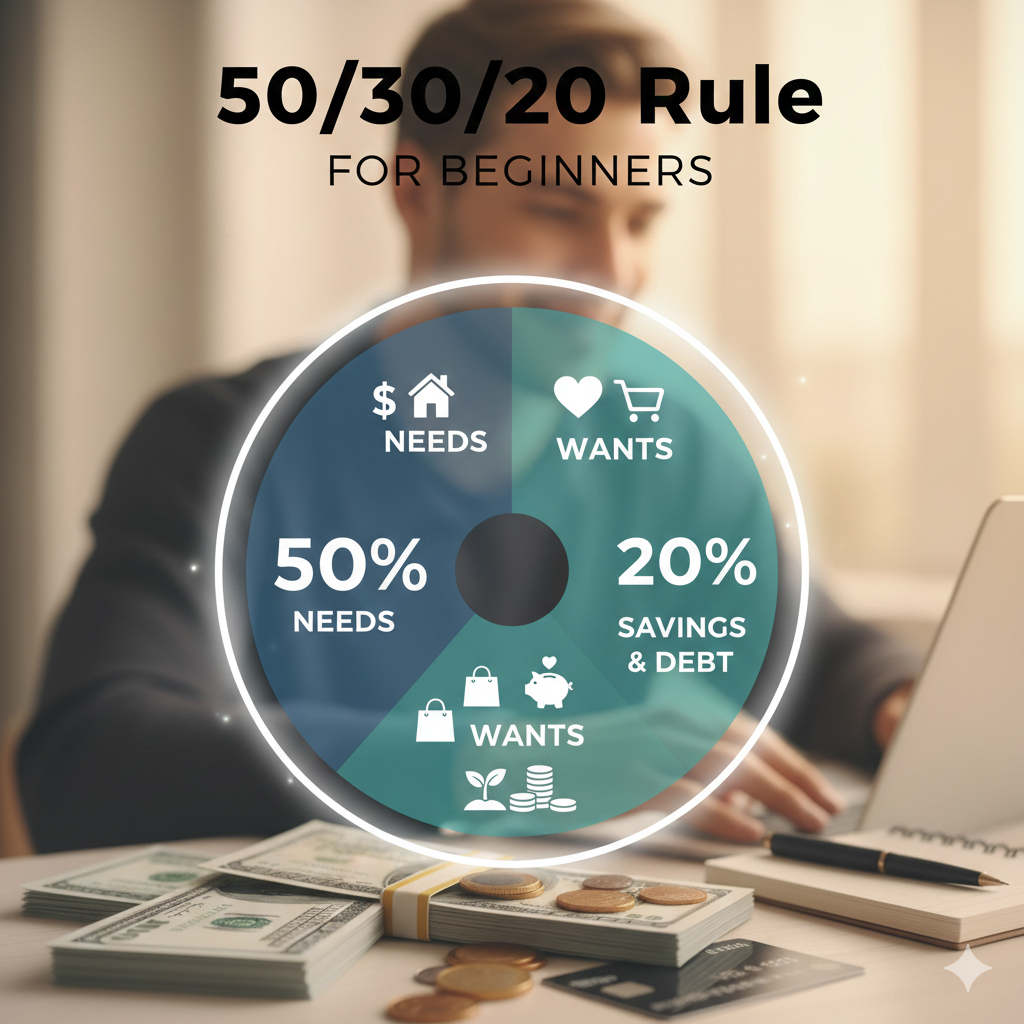
The 50/30/20 rule for beginners exists precisely because most people are not accountants and do not want to be. Created and popularized by U.S. Senator Elizabeth Warren in her book All Your Worth, this framework takes your after-tax income and splits it into exactly three buckets: 50% for needs, 30% for wants, and 20% for savings and debt. That is it. Three numbers. No color-coded spreadsheet required.
Is it perfect for every situation? No and we will get to that honestly. But is it the best starting point for anyone new to budgeting? Absolutely yes.
What Is the 50/30/20 Rule? A Beginner’s Explanation
At its core, the 50/30/20 rule is a percentage-based budgeting framework applied to your after-tax income meaning the actual money that lands in your bank account after the government takes its cut. Not your gross salary. Your take-home pay.
Here is the breakdown:
- 50% — Needs: The non-negotiables. Rent or mortgage, groceries, utilities, transportation, health insurance, and minimum debt payments. If your life basically falls apart without it, it is a need.
- 30% — Wants: The stuff that makes life enjoyable but is not strictly essential. Dining out, Netflix, gym memberships, new clothes, weekend trips. You could technically live without these. You just would not want to.
- 20% — Savings and Debt: Your future self’s share. Emergency fund, retirement contributions, paying down high-interest debt beyond minimums, and any other savings goals.
Simple, right? The elegance of the 50/30/20 budgeting rule is that it does not demand perfection. It demands direction. You are not tracking every dollar you are making sure your money is flowing into the right buckets in roughly the right proportions.
How Popular Is the 50/30/20 Rule? (Search Volume Data)
Here is a look at how many people are searching for 50/30/20 rule content every month useful context for understanding just how widely this budgeting method has been adopted:
| Keyword | Monthly Searches | Difficulty | CPC (USD) |
| 50/30/20 rule | 8,100 | 45 | $2.50 |
| 50 30 20 budget | 2,900 | 42 | $2.20 |
| 50/30/20 budgeting | 1,900 | 40 | $2.10 |
| what is 50/30/20 rule | 880 | 35 | $1.80 |
| 50/30/20 budget calculator | 590 | 32 | $1.90 |
| 50/30/20 rule for beginners | 210 | 20 | $1.30 |
| 50/30/20 rule example | 320 | 25 | $1.60 |
| 50/30/20 rule needs wants savings | 280 | 24 | $1.50 |
| how to use 50/30/20 rule | 240 | 22 | $1.40 |
| 50/30/20 rule low income | 48 | 7 | $0.90 |
| 50/30/20 rule couples | 45 | 6 | $1.00 |
| 50/30/20 rule student | 40 | 5 | $0.60 |
| 50/30/20 rule template | 120 | 14 | $0.90 |
| 50/30/20 rule spreadsheet | 80 | 13 | $0.80 |
| 50/30/20 rule tracker | 14 | 2 | $0.50 |
Monthly search volume data for 50/30/20 rule keywords source: personal finance SEO research, 2026.
How to Calculate Your 50/30/20 Budget — Step by Step
Using a 50/30/20 budget calculator or doing the math yourself takes about three minutes. Here is the exact process:
- Find your monthly after-tax income. Check your pay stub for net pay, not gross. If you are a freelancer, average your last three to six months of net earnings.
- Multiply by 0.50 for your needs ceiling. This is the maximum you should spend on essential expenses each month.
- Multiply by 0.30 for your wants allowance. This is your guilt-free spending money for everything discretionary.
- Multiply by 0.20 for savings and debt. This goes toward building your emergency fund, paying off debt, and investing for the future.
Here is what that looks like across different U.S. salary levels — all numbers are approximate based on a standard effective tax rate:
| Annual Salary | Monthly Take-Home* | Needs (50%) | Wants (30%) / Savings (20%) |
| $30,000 | ~$2,100 | ~$1,050 | ~$630 / ~$420 |
| $45,000 | ~$3,100 | ~$1,550 | ~$930 / ~$620 |
| $60,000 | ~$4,100 | ~$2,050 | ~$1,230 / ~$820 |
| $80,000 | ~$5,300 | ~$2,650 | ~$1,590 / ~$1,060 |
| $100,000 | ~$6,500 | ~$3,250 | ~$1,950 / ~$1,300 |
Take-home pay estimates based on approximate federal tax rates. State taxes will affect your actual figures.
Real example: You earn $60,000 per year and take home roughly $4,100 per month. Your 50/30/20 breakdown would be: $2,050 for needs, $1,230 for wants, and $820 for savings and debt. Every month. On autopilot.
Defining Needs vs Wants in the 50/30/20 Rule
This is where most beginners get tripped up, and honestly, it is the most important part of the whole simple 50/30/20 budgeting system. The line between needs and wants is blurrier than you think. Groceries are a need. DoorDash three nights a week is a want. Your phone bill is a need. A premium unlimited plan with every add-on is partially a want.
The honest test: Would my health, safety, or ability to work be seriously affected if I cut this? If yes, it is a need. If you would just be mildly annoyed or inconvenienced, it is probably a want.
| Needs (50%) | Wants (30%) | Savings & Debt (20%) |
| Rent or mortgage | Dining out & takeaways | Emergency fund |
| Groceries | Streaming services | 401(k) or IRA contributions |
| Utilities | Gym membership | High-interest debt payments |
| Health insurance | Shopping & clothing | House / car down payment fund |
| Minimum debt payments | Travel & vacations | Investments & brokerage |
| Transportation | Entertainment & hobbies | Other savings goals |
A practical breakdown of needs vs wants vs savings in the 50/30/20 rule for beginners.
One nuance worth knowing: minimum debt payments belong in the needs category because skipping them destroys your credit. Any payments above the minimum the extra you are throwing at a credit card or student loan belong in the savings/debt category.
Is the 50/30/20 Rule Suitable for Low-Income Beginners?
This is one of the most important and most honest questions to answer. The 50/30/20 rule on a low income can be genuinely difficult. If your rent alone eats up 60% of your take-home pay, you cannot magically make the math work by wishing harder.
The rule was not designed for people in survival mode. If you are spending 70% on needs, that does not mean you are bad at budgeting it means your income and housing costs are misaligned, and that is a structural problem, not a personal failure.
That said, the 50/30/20 framework still offers value even when the percentages are off:
- It shows you clearly where the pressure is coming from (usually needs like rent or healthcare)
- It gives you a target to work toward as your income grows
- It helps identify wants spending that could be temporarily redirected to savings or debt payoff
- Even saving 5–10% is meaningful progress you do not have to hit 20% on day one
The goal is progress, not perfection. Adjust the percentages to reflect reality, and move toward the ideal gradually.
How to Use the 50/30/20 Rule With Irregular Income
Freelancers, contractors, and side-hustle earners often wonder if the 50/30/20 rule for freelancers can work when your paycheck is a different number every month. It can with one key adjustment.
Instead of budgeting based on what you hope to earn, budget based on your lowest income month from the past six months. Call that number your baseline. Apply the 50/30/20 split to that. In higher-income months, put the extra into a buffer savings account. In lower months, draw from that buffer to stay on track. This creates the consistency that the rule needs to work, even when your income does not provide it naturally.
Apps like YNAB and EveryDollar are particularly well-suited to handling variable income within a 50/30/20 monthly budget framework both let you allocate funds as money arrives rather than assuming a fixed monthly income.
Should Beginners Prioritize Debt in the 20% Category?
Yes with some nuance. The 20% savings/debt bucket should serve multiple purposes simultaneously when you are starting out:
- Build a starter emergency fund first. Aim for $500 to $1,000 before aggressively attacking debt. Without this cushion, every unexpected expense pushes you back into debt.
- Then hit high-interest debt hard. Credit card debt above 15–20% APR is mathematically brutal. Paying it off is the best guaranteed return on your money.
- Contribute enough to get your employer 401(k) match. If your employer matches contributions up to 3%, contribute at least that much. It is an instant 100% return nothing beats it.
- Then build your emergency fund to 3–6 months of expenses. This is your financial immune system.
The beginner budget 50/30/20 approach does not require you to do all of this at once. Stack the priorities in the order above and work through them sequentially. Slow and steady beats chaotic and overwhelmed every single time.
Can You Adjust the 50/30/20 Percentages?
Absolutely and sometimes you should. The 50/30/20 rule is a framework, not a law. Elizabeth Warren herself described it as a guide, not a rigid formula. Here are some common adjustments that make sense for real life:
- High cost-of-living cities: If you live in NYC, LA, or San Francisco, your rent alone may eat 40–50% of take-home. Try 60/20/20 temporarily while you work on increasing income or reducing housing costs.
- Aggressive debt payoff mode: Slash wants to 15–20% and redirect the difference to debt. A 50/20/30 flip can cut years off a loan payoff timeline.
- Heavy saving phase (buying a house, early retirement): Compress wants to 20% and push savings to 30%. You are paying for future freedom.
- Students with minimal income: Focus on the structure track what you spend, identify which bucket it falls into, and work toward the ideal ratios as income grows.
The point is not to follow the numbers perfectly — it is to stop spending your entire paycheck on nothing in particular. Even an imperfect version of the 50/30/20 rule explained and applied beats no budget at all by a mile.
Best Free Tools to Start the 50/30/20 Rule as a Beginner
You do not need to spend money to implement the 50/30/20 rule for beginners. Here are the best apps, calculators, and templates available right now most of them completely free:
| App / Tool | Cost | Why Beginners Love It |
| NerdWallet Calculator | Free | Instant 50/30/20 split visualization based on your income — no sign-up needed. |
| EveryDollar | Free / $17.99/mo | Simple zero-based app; easy to map your 50/30/20 categories from day one. |
| Goodbudget | Free / Premium | Digital envelope system — perfectly mirrors the 50/30/20 three-bucket structure. |
| Empower | Free | Best free net worth and spending tracker; great for overlaying the 50/30/20 framework. |
| Budget Planner App (iOS) | Free | Auto-splits income by 50/30/20 and tracks habits — purpose-built for the rule. |
| YNAB | $14.99/mo | Most powerful budgeting app available; adapts to 50/30/20 with beginner workshops included. |
| PocketGuard | $7.99/mo | Shows how much is ‘in your pocket’ after needs and savings — perfect for managing wants. |
| Monarch Money | $14.99/mo | AI tips and clean dashboard; excellent for beginners building consistent money habits. |
| Quicken Simplifi | $3.99/mo | Intuitive spending plans that align directly with the three 50/30/20 categories. |
| Tiller (Google Sheets) | $79/yr | Auto-imports transactions into a 50/30/20 Google Sheets template — spreadsheet lovers rejoice. |
| Vertex42 Worksheet | Free | Free Excel template; fully customizable for tracking needs, wants, and savings manually. |
| 50/30/20 Planner (Etsy) | ~$5–$10 | Printable PDF worksheets for visual learners who prefer pen-and-paper budgeting. |
| Undebt.it | Free / Basic | Debt payoff tracker that fits perfectly into the 20% savings/debt category. |
| Rocket Money | $4–$12/mo | Identifies and cancels unused subscriptions — a quick win for trimming the 30% wants bucket. |
| Omni 50/30/20 Calculator | Free | Interactive online calculator with examples; ideal for understanding the math before you start. |
Best apps and tools for tracking the 50/30/20 rule from free calculators to full-featured budgeting apps.
Our pick for true beginners: Start with the NerdWallet 50/30/20 calculator to see your numbers instantly, then download Goodbudget or EveryDollar to put the framework into daily practice. Both are free and specifically designed around the concept of bucketing your spending.
How Often Should Beginners Review Their 50/30/20 Budget?
Once a month is the minimum and it does not need to take long. Set a recurring 20-minute calendar reminder, call it your ‘money check-in,’ and go through three questions:
- Did I stay within my needs budget? If not, what pushed me over?
- How did I do on wants? Any categories that surprised me?
- Did the full 20% actually go to savings or debt, or did it quietly evaporate?
Beyond monthly reviews, update your easy 50/30/20 guide numbers whenever something significant changes: a new job, a move, paying off a debt, a new baby, a raise. Your budget should reflect your actual life not a snapshot from eight months ago.
50/30/20 Rule vs Other Beginner Budgets — What’s the Difference?
There is no shortage of budgeting methods competing for your attention. Here is how the 50/30/20 rule compares to the two most popular alternatives for beginners:
- Zero-Based Budgeting: Zero-based budgeting assigns every dollar a specific job until income minus expenses equals zero. It is more powerful for serious debt fighters and detail-oriented people, but significantly more time-intensive. The 50/30/20 rule wins on simplicity and ease of entry.
- Dave Ramsey’s Baby Steps: Ramsey’s system is excellent for people in severe debt or financial crisis — it is aggressive, structured, and effective. But it restricts all investing until debt is paid, which most financial planners disagree with. The 50/30/20 approach allows saving and debt payoff simultaneously.
- Envelope Budgeting: Physical or digital envelopes work well for visual, tactile learners. Apps like Goodbudget digitize this beautifully. It is more granular than 50/30/20 but achieves a similar goal awareness and intentionality about where money goes.
Bottom line: the 50/30/20 rule for beginners is the lowest-friction entry point into structured budgeting. It is not the most precise system, but it is the most likely to actually get done and a budget you follow beats a perfect budget you abandon every single time.
Read:
- Good Money Management: The Habits That Actually Change Your Financial Life
- How to Create a Budget That Actually Works
Frequently Asked Questions About the 50/30/20 Rule for Beginners
What exactly counts as ‘needs’ in the 50/30/20 rule?
Needs are expenses you genuinely cannot skip without serious consequences: rent or mortgage, basic groceries, utilities, transportation to work, health insurance, and minimum debt payments. If cutting it would threaten your housing, health, or employment, it is a need.
How do I calculate my after-tax income for the 50/30/20 rule?
Use your net pay the amount that actually hits your bank account after federal, state, and local taxes are withheld. Find this on your pay stub under ‘net pay.’ For freelancers, subtract your estimated tax rate (typically 25–30% for self-employed) from your gross income to get a working after-tax figure.
What are examples of ‘wants’ under the 30% category?
Dining out, takeaways, streaming subscriptions, gym memberships, new clothing beyond basics, vacations and weekend trips, hobby spending, concerts, sports events, and any upgrades to necessities (like a premium phone plan when a basic one would work fine).
Can beginners adjust the 50/30/20 percentages if needed?
Yes, absolutely. The percentages are a starting guide, not a rule carved in stone. If your rent is unusually high, adjust the needs percentage upward temporarily and pull back on wants. The framework is most useful when it reflects your real constraints rather than an idealized scenario.
What free tools help implement the 50/30/20 rule for beginners?
The NerdWallet 50/30/20 calculator, Omni Calculator, Goodbudget (free version), Empower, EveryDollar (free version), the Vertex42 Excel worksheet, and printable 50/30/20 templates from Etsy are all excellent free starting points.
What is the difference between 50/30/20 and other beginner budgets?
The main difference is simplicity. The 50/30/20 rule explained in one sentence: three buckets, three percentages, done. Zero-based budgeting requires tracking every dollar. Dave Ramsey’s system restricts investing until debt is gone. The 50/30/20 rule asks far less of you up front — making it far more likely you will actually start
Start With Three Numbers. Change Everything.
Here is the truth about the 50/30/20 rule for beginners: it is not going to make you rich overnight. It is not going to eliminate debt in 90 days or fund your retirement in a year. What it will do if you actually follow it is stop the slow financial bleed that happens when you spend your entire paycheck without intention.
Fifty percent for what you need. Thirty percent for what you enjoy. Twenty percent for the future you want. That is it. Three numbers. A whole lot of clarity.
Start by running your numbers through the NerdWallet calculator or the salary table above. Pick one free app Goodbudget, Empower, or EveryDollar. Set up your three budget categories this weekend. Then check in once a month. You are not aiming for perfection. You are aiming for progress.
The best beginner budget 50/30/20 is the one you actually start. And there has never been a better time to start than right now.
Ready to Try the 50/30/20 Rule?
Grab the NerdWallet calculator, run your numbers, and download a free budget tracker today. Then drop a comment below — what is your biggest challenge with budgeting as a beginner? Let’s figure it out together.