Your paycheck lands, you feel rich for approximately 48 hours, then — poof. Gone. Here’s the brutally honest truth about why your salary disappears after payday, and the real steps to fix it — especially if you keep asking “Why Am I Always Broke After Payday?”
Okay, let’s be real for a second. Payday hits. Your bank notification pops up, you see that number, and for one glorious moment you feel like a functioning adult who has their life together. You treat yourself — maybe a nice dinner, a few things from Amazon, finally pay that overdue bill — and then somehow, within days, you’re back to checking your balance with one eye closed.
Sound familiar? You’re not alone. More than 60% of Americans live paycheck to paycheck, according to a 2024 LendingTree study on paycheck-to-paycheck living. That’s not just lower-income households either. We’re talking people earning $100,000+ a year who still run out of money before the next payday rolls around. The Consumer Financial Protection Bureau (CFPB) offers free budgeting worksheets that can help you see where every dollar is going — and it’s often eye-opening.
So, what gives? Why does your salary disappear after payday like it never existed? Let’s talk about it — honestly, without judgment — because the reasons are almost always fixable once you actually see them. Jump ahead to our step-by-step fixes if you’re ready to act right now.
Table of Contents

- 62% of Americans live paycheck to paycheck
- $400 is all most people have for emergencies
- 3–5×more spent in days after payday vs. end of month
- 78% who overspend do so within 72 hrs. of payday
Is It Normal to Be Always Broke After Payday?
First, let’s settle this: yes, it’s incredibly common — but that doesn’t make it okay. There’s a difference between “normal” and “healthy.” Millions of people run out of money after payday every single month, and most of them never figure out why. They assume they just don’t earn enough. Sometimes that’s true. But more often? It’s something else entirely.
Being broke right after payday is a symptom, not the disease. The real disease is usually a mix of spending psychology, lack of a system, and some sneaky financial habits you probably don’t even realize you have. Let’s get into them.
The problem isn’t that you spend too much. It’s that you don’t know where it goes until it’s already gone.— A truth most personal finance experts will tell you
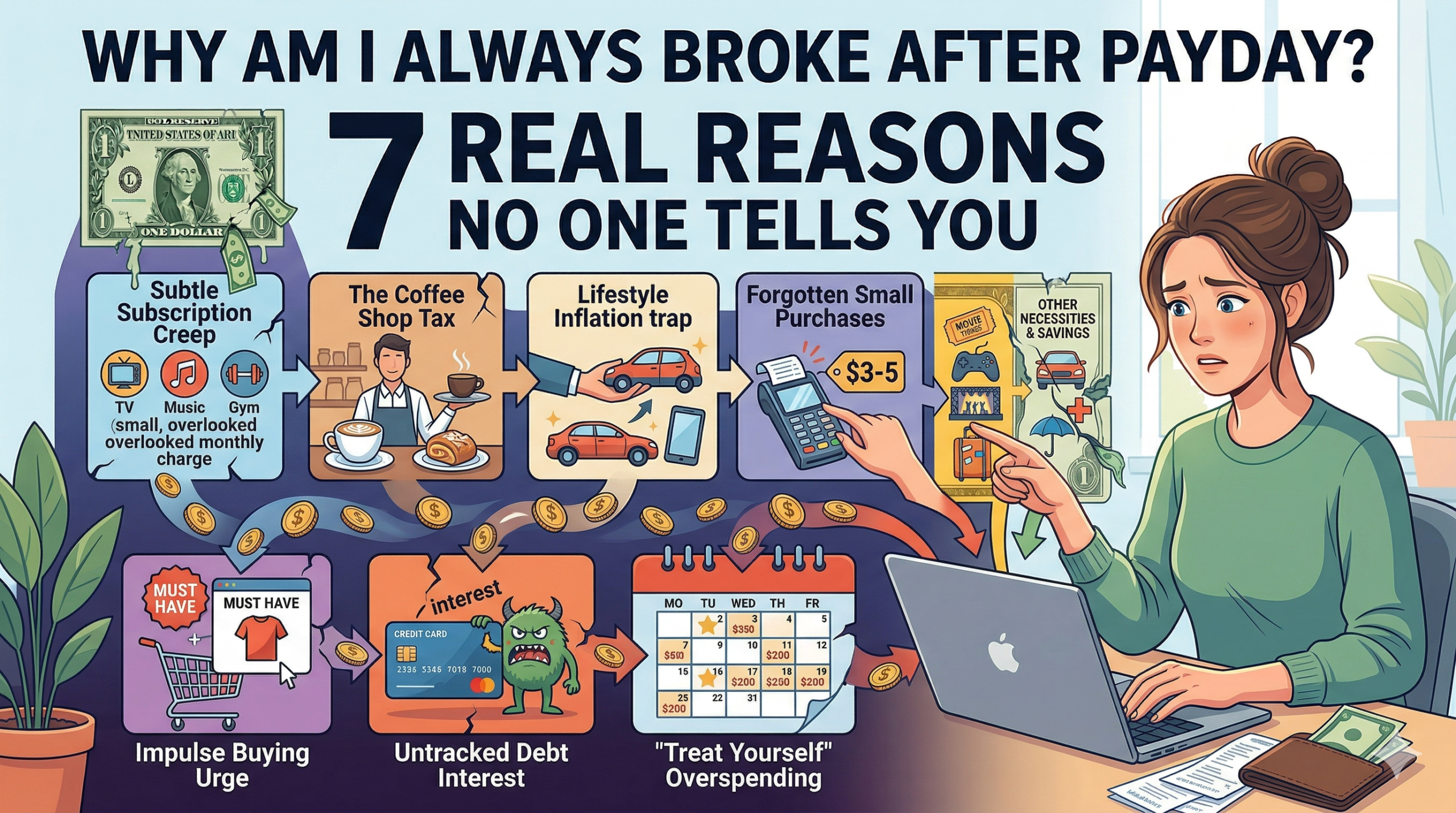
7 Real Reasons Why You’re Always Broke After Payday
- The “Payday Splurge” Is a Real Psychological Trap
- The second money hits your account, your brain switches into reward mode. Psychologists call this “mental accounting” — you suddenly feel wealthy, so you spend like it. If you’ve ever caught yourself wondering, Why Am I Always Broke After Payday?, this is often where it starts. That dinner out, the impulse Target run, the DoorDash order because “you deserved it” after a long pay period — it all adds up. Fast.
- Your Bills Are on Autopilot (And You Forgot About Them)
- Rent, car insurance, Netflix, Spotify, gym membership, student loan payment, phone bill — they all lurk in the background. A few days after payday, they hit your account like a wave and suddenly half your check is just… gone. When was the last time you actually added up all your recurring expenses?
- You Have No Budget — Or a Budget You Never Follow
- Writing a budget and actually living by one are two very different things. Most people who say “I have a budget” mean “I kind of know roughly what I spend.” That’s not a budget. That’s a vibe. And vibes don’t build savings accounts.
- You’re Paying for Things You Don’t Use Anymore
- Subscriptions are sneaky little money vampires. That meal kit service you signed up for during a health kick six months ago? Still billing you $80/month. The premium app you downloaded once? $14.99, every month, without fail. These small leaks drain your paycheck quietly.
- Your Fixed Expenses Are Too High Relative to Your Income
- If your rent, car payment, and loan minimums add up to more than 50% of your take-home pay, you’re fighting a losing battle. No amount of “cutting lattes” will fix a structural income-to-expense imbalance. This is a big-picture problem that requires a big-picture solution.
- Lifestyle Creep Is Eating Your Raise
- Got a raise last year? Promoted recently? If your spending grew as fast (or faster) than your income, you might actually feel more broke now than before. This is called lifestyle creep and it’s extraordinarily common. You earn more, you spend more — net result: same broke feeling.
- You Have No Emergency Fund
- Life is chaotic. Your car breaks down, your dog gets sick, your fridge stops working. Without an emergency fund, every unexpected expense obliterates your budget. You end up spending money earmarked for groceries or next month’s bills, creating a financial hole you spend weeks digging out of.
- Peer Pressure and Social Spending
- Your friends want to go to the concert. The group chat is booking a weekend trip. You feel guilty saying no, so you swipe the card. Social spending is one of the most underrated budget killers in America. FOMO is expensive.

Why Am I Always Broke After Payday Even with a Decent Salary?
This one really messes with people’s heads. You’re earning $65,000, $80,000, maybe more — and you still find yourself asking “why am I always broke after payday?” What is going on?
Here’s the hard truth: income level and financial stability are not the same thing. A person earning $40,000 who spends $35,000 is in better shape than someone earning $90,000 who spends $95,000. It’s not about how much you earn. It’s about the gap between what you earn and what you spend.
Taxes take a bigger bite at higher incomes. Lifestyle expectations rise. Social circles get more expensive. And the higher you earn, the more creative your spending gets — nicer car, bigger apartment, better restaurants. It’s a treadmill.
Quick Reality Check
Write down your take-home pay after taxes. Then list every single expense — fixed bills, variable spending, subscriptions, everything. Now subtract expenses from income. If that number is zero or negative, you’ve found your problem.
If it’s positive but you’re still broke, the gap is going somewhere untracked. That’s where you need to look.
Signs You’re Always Broke After Payday — Are You Overspending?
Sometimes it’s hard to admit there’s a problem — especially when each individual purchase feels totally reasonable. If you keep wondering Why Am I Always Broke After Payday? these warning signs will tell you exactly what’s happening:
You feel anxious checking your bank balance a week after payday
You regularly move money between accounts just to cover basics
You tell yourself “I’ll start saving next month” — every month
You can’t name exactly where $200+ of your paycheck went last month
You carry a credit card balance month to month
Unexpected expenses (a car repair, a dentist visit) send your budget into crisis mode
You’ve declined a social event due to money but can’t pinpoint why you’re short
Sound familiar? Even if just two or three of those hit home, it’s worth paying attention.
CHECK OUT:
Should You Save or Pay Bills First? (Key Fix If You’re Always Broke After Payday)
This is one of the most common questions from people wondering why am I always broke after payday, and the answer might surprise you: save first, then pay bills. This is the core principle behind the “pay yourself first” philosophy that every financial advisor worth their salt will recommend. NerdWallet explains the pay-yourself-first method in detail if you want a deeper dive.
The psychological trick here is powerful. If you wait until the end of the month to save whatever’s left, there’s never anything left. But if you automate a savings transfer on payday — even just $50 or $100 — it happens before you have a chance to spend it.
Here’s a simple order of operations for payday:
| # | Action | Why It Matters | How Much |
|---|---|---|---|
| 1 | Transfer to savings / emergency fund | Pay yourself first — non-negotiable | At least 10% of take-home |
| 2 | Pay rent / mortgage | Housing is your foundation | Ideally ≤30% of gross income |
| 3 | Pay essential bills (utilities, insurance, loan minimums) | Avoid late fees and credit damage | Track every one |
| 4 | Set aside grocery/food budget | Non-negotiable living expense | $300–$600 for 1–2 people |
| 5 | Allocate fun / discretionary money | Guilt-free spending within limits | Whatever’s left after steps 1–4 |
If step 5 leaves you with almost nothing for fun, that’s important information. It means your fixed expenses are too high and something bigger needs to change.
How to Stop Being Always Broke After Payday — 5 Fixes That Work
Enough diagnosing. Let’s fix this. Here’s what actually works — not the generic “track your spending” advice everyone ignores, but real, actionable steps that address why you’re always broke after payday.
1. Do a Subscription Audit — Stop the Silent Leaks After Payday
Log into your bank or credit card app and scroll through the last 60 days of transactions. Highlight every recurring charge. Add them up. Be honest about which ones you actually use and love versus which ones are just… there. Cancel ruthlessly. Most people find $50–$150/month in subscriptions they forgot existed. Tools like Rocket Money (formerly Truebill) can automate this audit for you in minutes.
2. Try the Cash Envelope Method to Avoid Being Broke After Payday
Old school, yes. Effective, absolutely. Assign specific amounts to specific spending categories — groceries, gas, dining out, entertainment. Use cash envelopes or budget apps like YNAB (You Need A Budget) or EveryDollar that mimic this system digitally. When the envelope is empty? That category is done for the month. Full stop.
3. Build a No-Spend Buffer Week
Once a month, designate one full week where you spend nothing beyond absolute necessities. Cook from what’s in your pantry. Skip the coffee shop. Skip Amazon. That week alone can save you $100–$300 depending on your habits, and it resets your relationship with impulse spending.
4. Automate Savings on Payday
Set up an automatic transfer to a separate savings account the same day your paycheck hits. Make it a high-yield savings account (most online banks now offer 4–5% APY). Even $75/paycheck is $1,800/year. It adds up, and you’ll barely notice it if it’s automatic.
5. Use a Waiting Rule for Non-Essential Purchases
Before any non-essential purchase over $30, implement a 48-hour wait. Just don’t buy it immediately. Most impulse purchases feel unnecessary two days later. This one habit alone can dramatically reduce how much your salary disappears after payday.
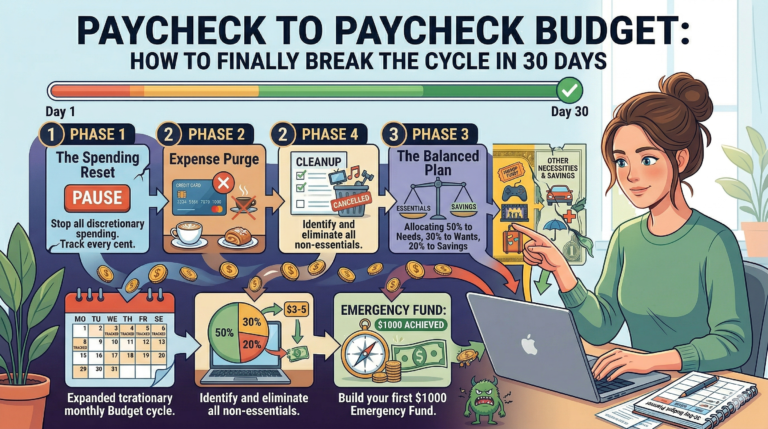
Pro Tip — The 50/30/20 Rule
50% of take-home pay → Needs (rent, bills, groceries, transportation)
30% of take-home pay → Wants (dining out, entertainment, shopping)
20% of take-home pay → Savings and debt payoff
If your “needs” category is eating 70–80% of your check, that’s the core answer to why you’re always broke after payday — and a budget tweak alone won’t solve it. You may need to increase income or significantly reduce a fixed expense like housing or car payments. Investopedia’s full breakdown of the 50/30/20 rule is worth bookmarking.
CHECK OUT:
How to Build an Emergency Fund When You’re Always Broke After Payday
Here’s the catch everyone hates: you need an emergency fund to stop being broke after payday, but you’re too broke to build one. Classic — and it’s a big reason people keep asking, Why Am I Always Broke After Payday? According to the Federal Reserve’s Report on Economic Well-Being, nearly 37% of Americans couldn’t cover an unexpected $400 expense without borrowing. But here’s how to actually start:
- Here’s the catcheveryone hates: you need an emergency fund to stop being broke after payday, but you’re too broke to build one. Classic — and it’s a big reason people keep asking, “Why Am I Always Broke After Payday?” According to the Federal Reserve’s Report on Economic Well-Being, nearly 37% of Americans couldn’t cover an unexpected $400 expense without borrowing. But here’s how to actually start:
- Start absurdly small. $10/paycheck. Seriously. Just start. The habit is more important than the amount right now.
- Sell stuff. Old electronics, clothes you haven’t worn, furniture — Facebook Marketplace and eBay can produce a quick $200–$500 starting fund.
- Put your tax refund directly in. The average U.S. tax refund is around $3,000. If you’re getting one, resist the urge to spend it. That’s an emergency fund right there.
- Use a separate account. Put it somewhere you can’t easily access — a different bank if possible. Out of sight genuinely means out of mind.
- Your goal: $1,000 first, then work toward 3 months of expenses. But $1,000 handles most car repairs, medical copays, and minor emergencies that currently derail your whole budget.
CHECK OUT:
Why Am I Always Broke After Payday? — Your Questions Answered
Why does my salary disappear as soon as it hits my account?
Because your bills, autopayments, and spending impulses are all timed around payday — often without you realizing it, which is a major reason people keep asking “Why Am I Always Broke After Payday?” The solution is to map out exactly when every bill hits and proactively budget before spending anything discretionary.
Does living paycheck to paycheck mean I’m poor?
No — it means your expenses are keeping pace with (or exceeding) your income, which is exactly why so many people find themselves asking “Why Am I Always Broke After Payday?” Many high earners live this way. It’s a cash flow problem, not necessarily a low-income problem, though both can contribute.
Is it better to use cash or cards to avoid overspending after payday?
Research shows people spend less with cash because it feels more “real.” If you’re a habitual overspender, try using cash for discretionary categories (groceries, dining, entertainment) while keeping bills on autopay with your debit/credit card.
How can I handle unexpected expenses without going broke?
Build that emergency fund — even $500 changes everything. Also consider “sinking funds”: small monthly savings set aside for predictable-but-irregular expenses like car maintenance, annual subscriptions, or holiday gifts.
Should I cut subscriptions and side expenses to stop being broke?
Yes, but don’t stop there. Cutting subscriptions is a great first step, but if your housing or debt payments consume too much of your income, those small cuts won’t move the needle much. Address the big fixed expenses too.
What are the best apps to track where my money goes each month?
YNAB (You Need A Budget) is widely considered the gold standard. Mint (now discontinued, but alternatives like Monarch Money or Copilot exist), EveryDollar (Dave Ramsey’s app), and even a simple Google Sheets budget work great depending on your style.
Can a side hustle fix being broke after payday?
Potentially — but only if you fix your spending habits too. More income without better habits often just means more lifestyle creep and the same broke feeling at a higher salary. Side hustles are most effective when the extra income goes directly to savings or debt payoff.
The Bottom Line: Stop Asking “Why Am I Always Broke After Payday” — Start Here
Being broke after payday is frustrating, embarrassing, and exhausting — but it’s almost never hopeless. The fact that you’re asking Why Am I Always Broke After Payday? Already puts you ahead of the people who never stop to question it. If you’ve been stuck in this cycle, wondering Why Am I Always Broke After Payday?, it’s important to know this is a solvable problem. Not overnight, not without some friction, but absolutely solvable — and thousands of people in worse financial situations than yours have done it.
The thing that changes everything isn’t a magic budgeting app or some clever financial hack. It’s awareness. Knowing exactly where your money goes. Making intentional decisions with it. Building even a tiny buffer that keeps life’s curveballs from knocking you flat.
You don’t have to be perfect. You don’t have to slash every joy from your life. But you do have to stop letting your paycheck run the show while you watch from the sidelines.
Start small. Start today. And start with one thing — whether that’s canceling two subscriptions, setting up a $50 automatic savings transfer, or just writing down every dollar you spend this week. One thing leads to another. That’s how this works. And if you need a reminder of the exact steps, scroll back up to our 5 proven fixes.