You’re not bad with money. You just never had a paycheck-to-paycheck budget that was built for real life. Here’s the honest, step-by-step system that actually works — starting with your very next payday.
Let me paint you a picture. It’s payday. Your direct deposit lands, you feel that familiar little rush — okay, we’re good and then, like clockwork, by day five or six, your account looks like it never happened. Bills came out, groceries happened, life happened. And now you’re white knuckling it until the next payday again.
Sound exhausting? It is. And if that cycle has been your normal for months — or years — you’re not failing at personal finance. You’re just using the wrong system. A traditional monthly budget doesn’t work when your money doesn’t arrive in one neat lump on the first of the month. What you actually need is a paycheck to paycheck budget: a system built around how money actually flows in and out of your life.
Table of Contents
And here’s the thing — you can genuinely start breaking this cycle in 30 days. Not by cutting every joy from your life. Not by pretending coffee is a luxury you don’t deserve. Just by getting smarter about how you assign each dollar the moment it arrives. Let’s get into it.

- 62% of Americans live paycheck to paycheck in 2024
- $0 saved by people with no budget system in place
- 30 days to build a functioning paycheck budget habit
- 3× less likely to overdraft with a paycheck-aligned budget
What Is a Paycheck to Paycheck Budget?
A paycheck to paycheck budget is exactly what it sounds like — a budgeting method where you plan your spending around each individual paycheck rather than treating the whole month as one giant pool of money. Instead of saying “I have $3,000 this month,” you say “I have $1,500 this Friday, and here’s exactly what it covers.”
This is a fundamental shift in how you think about money. Most traditional budgeting advice was designed for people with a single large monthly income — think salaried professionals who get paid once a month. But most working Americans are paid biweekly or weekly. That means your rent due on the 1st might have nothing to do with your payday on the 7th. The mismatch between when money arrives and when bills are due is often the root cause of the paycheck to paycheck cycle — not overspending.
When you build a proper paycheck budgeting system, you match every obligation to a specific payday. You know that Paycheck 1 covers rent and utilities, and Paycheck 2 covers groceries, insurance, and savings. Nothing is left to chance or “vibes.”
A budget isn’t a restriction on your freedom. It’s the plan that gives you freedom within your actual income.— Dave Ramsey, personal finance author and radio host
Paycheck Budget vs. Monthly Budget: Which One Actually Works?
This is a fair question and the honest answer is: it depends on how you get paid. But for most Americans living paycheck to paycheck, the paycheck-aligned method wins. Here’s why:
| Feature | Monthly Budget | Paycheck to Paycheck Budget |
|---|---|---|
| Best for | Single monthly salary earners | Weekly / biweekly pay earners |
| Cash flow alignment | Often mismatched with pay dates | Perfectly aligned with each payday |
| Overdraft risk | Higher — money gets spent before bills hit | Lower — bills are pre-assigned to paychecks |
| Savings visibility | Easy to “forget” to save until month-end | Built in from each paycheck |
| Works for irregular income? | Somewhat | Yes, with a flex baseline approach |
| Complexity | Simple to set up, hard to stick to | Slightly more setup, much easier to maintain |
| Ideal for debt payoff | Harder to schedule payments | Assign a debt payment to every paycheck |
The monthly budget feels simpler because it’s the one we learned in school. But feeling simple and actually working are two different things. When your bills don’t line up with your pay dates, a monthly budget becomes a puzzle with missing pieces. The paycheck to paycheck budget closes that gap completely.
How to Create a Paycheck to Paycheck Budget in 6 Steps
Ready to build yours? This doesn’t require a finance degree or an expensive app. A spreadsheet and 45 minutes of honest effort will do the job. Here’s exactly how to create a paycheck to paycheck budget from scratch:
- List Every Source of Income and Its Pay Dates Write down every paycheck you receive — from your job, side hustle, freelance work, whatever. Note the exact dates or pay schedule (weekly, biweekly, semi-monthly). This is your foundation. Everything else gets built around it.
- List Every Single Expense — Fixed and Variable Pull up two to three months of bank statements and capture everything. Rent, utilities, car payment, subscriptions, groceries, gas, dining out — all of it. Categorize them into fixed (same amount every time) and variable (amount changes). Don’t judge yourself. Just list it.
- Note the Due Date of Every Bill This is the step most budgets skip and it’s the most important one. Go through each expense and note when it’s actually due. Bills due on the 1st, 5th, 15th, 28th — knowing this lets you match each one to the right paycheck.
- Assign Each Bill to a Specific Paycheck This is the core of the paycheck bucket budget method. Look at your pay dates and your bill due dates side by side. Assign each bill to the paycheck that arrives just before it’s due. Paycheck on the 1st? It covers rent on the 1st and the electric bill on the 5th. Paycheck on the 15th? It covers car insurance on the 18th and groceries all week.
- Add a Savings Line to Every Single Paycheck Even if it’s $25. Even if it’s $10. The moment you stop treating savings as “whatever’s left,” everything changes. Make it a line item assigned to a specific paycheck — not a wish for the end of the month.
- Track Spending Between Paydays — Every Time A paycheck budget only works if you check in regularly. Spend 5 minutes every evening or every other day reviewing your spending against your plan. Overspent on dining out? Pull $20 from your entertainment category this pay period. Adjust in real time, not in regret.
Pro Move — The “Buffer $100” Rule
When assigning bills to paychecks, always keep a $100–$200 unassigned buffer in your checking account. This is not spending money. It’s your overdraft shield. Bills sometimes hit a day early. Autopayments have timing quirks. The buffer protects you silently.
Most people who stop overdrafting do so simply by keeping a small cushion — not by earning more money.
The Paycheck Bucket Method: Stop Treating Your Account Like One Big Pot
One of the biggest mindsets shifts in budgeting paycheck to paycheck is learning to see your money in buckets, not as one pool. When everything sits in one checking account with no labels, your brain treats the whole balance as “available.” That’s how you end up spending rent money on a good weekend without realizing it.
The paycheck bucket method gives every dollar in your paycheck a specific label the moment it arrives. Here’s a simple example of what buckets might look like:
| Bucket Name | What It Covers | % of Paycheck | Account Type |
|---|---|---|---|
| 🏠 Bills & Fixed Costs | Rent, utilities, insurance, loan payments | 45–55% | Checking (bills account) |
| 🛒 Everyday Living | Groceries, gas, household supplies | 15–20% | Checking (spending account) |
| 🎉 Fun Money | Dining out, entertainment, personal spending | 5–10% | Checking or cash envelopes |
| 🛡️ Emergency Buffer | Unexpected expenses, overdraft protection | 5% | Savings account |
| 💰 Savings / Goals | Emergency fund, vacation, debt payoff | 10–20% | High-yield savings account |
You don’t need five separate bank accounts to run this system. You can track it with a spreadsheet, a budgeting app, or even a notebook. The point is the mental assignment — knowing that $640 of your $1,500 paycheck is already spoken for by bills before you spend a single dollar on fun.
Your 30-Day Plan to Break the Paycheck to Paycheck Cycle
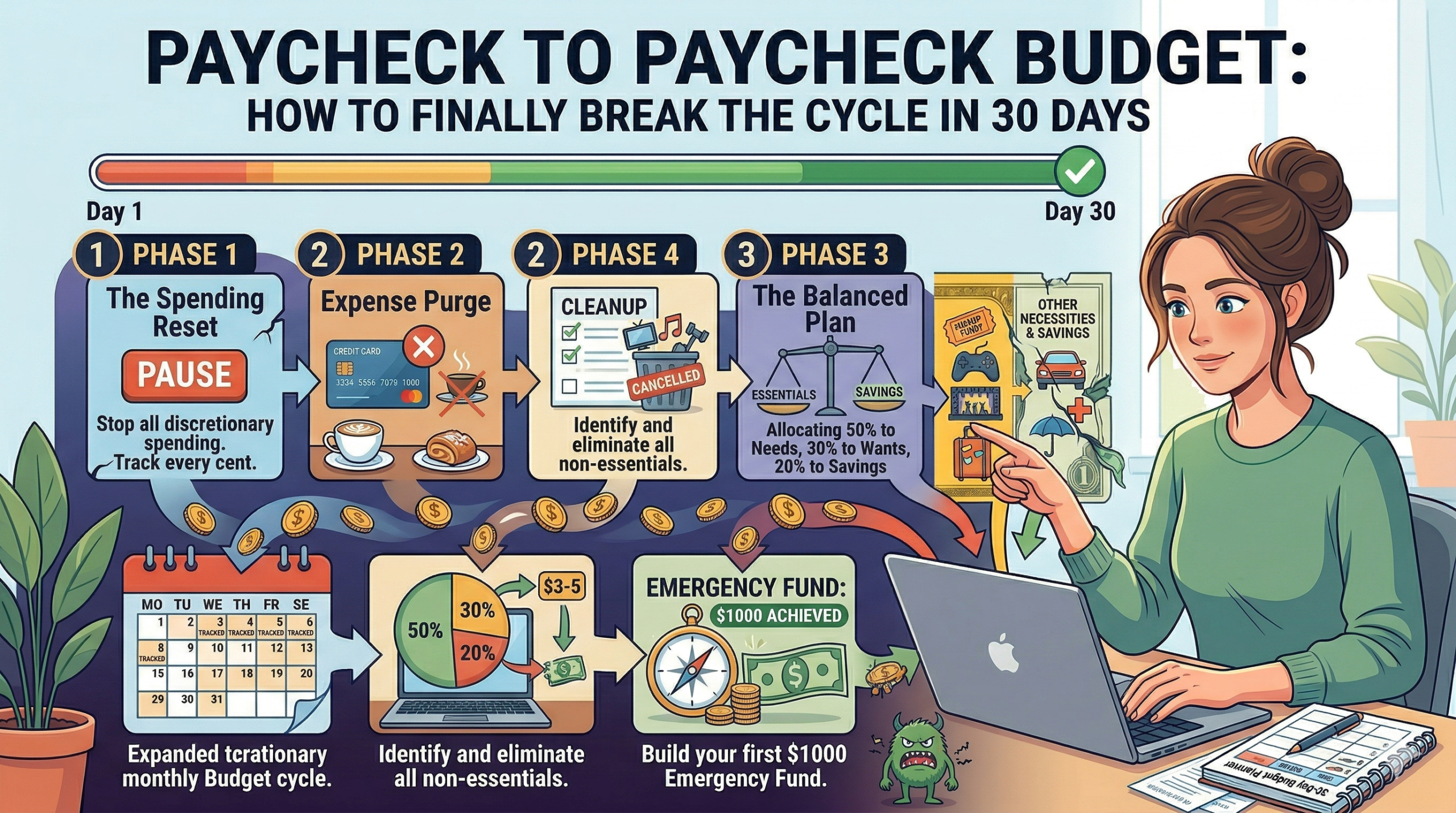
Okay, here’s where it gets practical. Not theoretical. Not “someday.” Here’s your actual 30-day paycheck to paycheck budget action plan, broken into four weekly phases:
Week 1 · Days 1–7
Audit & Awareness
Pull three months of bank statements. List every expense. Calculate your real take-home pay. Don’t budget yet — just look. Most people are shocked by what they find.
Week 2 · Days 8–14
Build Your Paycheck Map
Assign every bill to a specific paycheck. Create your buckets. Set up your savings line item — even if it’s tiny. This is where your paycheck to paycheck budget gets built.
Week 3 · Days 15–21
Live the Budget
Follow your plan. Track every purchase. Adjust categories that are off. This week will feel uncomfortable — that’s normal. You’re retraining your habits, not just your spreadsheet.
Week 4 · Days 22–30
Review & Lock In
Review what worked and what didn’t. Refine your paycheck buckets. Cancel one subscription you forgot about. Celebrate that you made it 30 days. That’s real progress.
Thirty days won’t fix everything. But it will absolutely change your relationship with money — and that’s where every lasting financial transformation starts. The cycle doesn’t break in a moment of inspiration. It breaks in small, repeated decisions made every payday.
How to Budget Paycheck to Paycheck on Biweekly Pay
Getting paid biweekly — every two weeks — creates a specific challenge: two months a year you get three paychecks instead of two. Most people spend that “bonus” paycheck without thinking. Smart paycheck budgeters treat it as a wealth-building opportunity.
Here’s how to set up a biweekly paycheck budget that works:
- Paycheck 1 of the month → Covers rent/mortgage, one utility bill, groceries for two weeks, and your savings transfer
- Paycheck 2 of the month → Covers car payment, insurance, remaining utilities, entertainment budget, and debt minimum payments
- Third paycheck months → Use it entirely for debt payoff, emergency fund top-up, or a specific savings goal. Don’t absorb it into regular spending
The key with a biweekly paycheck budget template is splitting your monthly obligations intelligently so neither paycheck is completely overwhelmed. Some people split rent 50/50 across both paychecks. Others pay it fully from one and use the other for everything else. Either works — as long as it’s intentional and written down before payday arrives.
For a deeper breakdown, see our guide on how to create a zero-based budget.
Biweekly Budget Quick-Start Table
Paycheck 1 (1st of month): Rent · Electric · Groceries · Savings transfer
Paycheck 2 (15th of month): Car payment · Phone · Internet · Gas · Fun money
Extra 3rd paycheck (twice a year): Emergency fund · Extra debt payment · Annual bills like car registration
How to Save Money While Living Paycheck to Paycheck
This is the question everyone asks, and nobody believes the answer to: yes, you can save money while living paycheck to paycheck — even if you keep wondering “Why Am I Always Broke After Payday?” The trick is starting so small that it feels almost meaningless — because that’s how habits form. Big, dramatic savings goals collapse under their own weight. Small, automatic transfers survive.
Here’s a practical approach to saving within a paycheck-to-paycheck budgeting system:
Start with 1%
On a $1,500 paycheck, that’s $15. Move it into a separate high-yield savings account automatically on payday. You won’t miss it. But in six months, it becomes $180 — which is more than most broke-after-payday people have saved in years.
Compare top options here:
https://www.nerdwallet.com/best/banking/high-yield-online-savings-accounts
Use Sinking Fund
Car registration, holiday gifts, annual subscriptions — divide the yearly cost by 26 paychecks and save that amount each pay period. When the bill arrives, the money is already there.
Learn more about sinking funds:
https://www.ramseysolutions.com/budgeting/what-is-a-sinking-fund
Direct Your Tax Refund
The average American gets about $3,100 back at tax time. Resist the urge to “treat yourself” with all of it. Put at least half into your emergency fund. One $1,500 cushion completely changes how your paycheck-to-paycheck budget feels.
IRS refund info:
https://www.irs.gov/refunds
Apply the “Found Money” Rule
Raise? Side hustle payment? Birthday cash? Before your brain assigns it a purpose, transfer 50% to savings. The other 50% can be guilt-free fun. This builds savings without feeling like sacrifice.
You might also like: Why are my always broke after payday?
Emergency Fund Goal Ladder
Level 1 — $500
Covers most car repairs, medical copays, small emergencies
Level 2 — $1,000
The Dave Ramsey “Baby Step 1” starter fund
Level 3 — 1 Month Expenses
Real breathing room. Significantly reduces paycheck-to-paycheck stress
Level 4 — 3–6 Months Expenses
True financial stability. The goal to work toward over 12–24 months
YOU MIGHT ALSO LIKE:
- How to Stop Overspending: 10 Brutally Honest Reasons You’re Blowing Your Budget
- POSTHow to Budget When You Are Broke: Your 2026 Survival Plan
- How to Pay Off Debt Fast on a Low Income: 10 Proven Steps That Actually Work
Handling Irregular Income With a Paycheck to Paycheck Budget
Freelancers, gig workers, commission earners — this section is for you. Building a paycheck budget for irregular income requires one extra mental move: you need to create a fake “stable paycheck” from your variable earnings.
Here’s how it works. Look at your last six months of income. Find your lowest monthly total. That number becomes your conservative baseline — your “pretend salary” for budget purposes. Every month, you only budget that amount, even if you earned more. The extra goes straight to a holding account first, then gets distributed in lean months when earnings dip below your baseline.
This approach, sometimes called a flex budget, is used by professional freelancers who’ve escaped the feast-or-famine cycle. You’re not budgeting around what you hope to earn. You’re budgeting around what you reliably earn, and everything above that becomes a financial safety net manually first. Once you understand how your money flows, invest in a tool that automates the tedious parts.

FAQs About Paycheck to Paycheck Budget
Is a paycheck to paycheck budget better than a monthly budget?
For most Americans paid biweekly or weekly, yes. A paycheck to paycheck budget aligns your expense plan with when money actually arrives, which dramatically reduces overdrafts, missed bills, and the end-of-month panic that a traditional monthly budget creates.
What are paycheck “buckets” and how do they work?
Paycheck buckets are spending categories assigned to a specific paycheck. Instead of one big pool of money, you divide each paycheck into labeled buckets — bills, groceries, fun, savings — so every dollar has a job before you spend it. This is the core of the paycheck bucket budget method.
How do I handle irregular bills with a paycheck budget?
Divide the annual cost by the number of paychecks you receive per year (26 if biweekly) and set aside that small amount every pay period into a sinking fund. When the bill arrives — car registration, annual subscriptions, holiday costs — the money is already waiting.
Should I pay myself first in a paycheck to paycheck budget?
Absolutely. Make savings the first line item on every paycheck — not the last. Even $10 to $25 per paycheck trained as an automatic transfer change your financial psychology. You stop “saving what’s left” and start building real financial stability.
What if my paycheck amount changes each month?
Use the flex budget approach: budget based on your lowest recent paycheck amount. If you earn more, move the extra to savings or a holding account first. This keeps your paycheck budgeting system stable even when income fluctuates.
How do I track spending between paydays?
Check your budget briefly every day or every other day — it takes less than five minutes. Apps like YNAB and Monarch Money make this almost effortless. If you prefer manual tracking, a simple notes app where you log each purchase throughout the day works just as well.
What’s the best paycheck to paycheck budget template for beginners?
Start with a simple Google Sheets or Excel spreadsheet. Create columns for: Paycheck Date, Total Amount, Bill/Expense Name, Due Date, Amount, and Bucket Category. List all your recurring bills under the paycheck that arrives before each due date. Keep it simple — complexity is the enemy of consistency
The Bottom Line: Your Paycheck to Paycheck Budget Starts Now
Here’s the truth nobody tells you: the paycheck to paycheck cycle isn’t a money problem. It’s a system problem. For years, you’ve been using a budgeting approach designed for a financial life that doesn’t look anything like yours. A monthly budget built for someone with a different pay schedule, different bills, different rhythms.
A paycheck to paycheck budget is simply the right tool for the life you actually have. It aligns your plan with your pay dates. It stops the mismatch between when bills arrive and when money does. It makes savings automatic instead of aspirational. And when you stick with it for 30 days — not perfectly, but consistently — something genuinely shifts.
You stop white knuckling it until payday. You stop that low-key anxiety every time you open your banking app. You start to feel like your money is actually working with you rather than escaping from you the moment it arrives.