
Let me be honest with you. Most savings advice is boring, vague, and sounds like it was written by someone who has never had to choose between groceries and a bill: “Cut your lattes.” “Make a budget.” Sure — thanks. Super helpful.
But here’s one idea I keep coming back to: the 52-Week Money Saving Challenge. It’s stupidly simple. You save $1 in week one, $2 in week two, $3 in week three — and you just keep going. By the time December rolls around, you’ve quietly stacked $1,378 without making any dramatic life changes. No meal prepping 30 days ahead. No side hustle required at 11 PM.
Is it the fastest way to get rich? No. But is it one of the most painless ways to build a savings habit that actually sticks? Absolutely. And if you’re someone who’s tried budgeting before and found it suffocating, this might just be your sweet spot.
- $1,378 Total saved in 52 weeks
- $1 Amount you start with
- 52 Weeks, one year
- $26.50 Average weekly deposit
So, What Exactly Is the 52-Week Money Challenge?
Think of it as a savings game with one rule: each week, you save the dollar amount that matches the week number. Week 1? Save $1. Week 17? Save $17. Week 52 — the grand finale — you drop in $52. Add it all up and you’ve got yourself $1,378 by New Year’s Eve.
This is the essence of the 52-Week Money Saving Challenge. The genius of it is the psychology. Starting with just one dollar removes the pressure completely. There’s no intimidating “save 20% of your income” mandate. No spreadsheet with seventeen tabs. You just start — small — and let momentum do the heavy lifting.
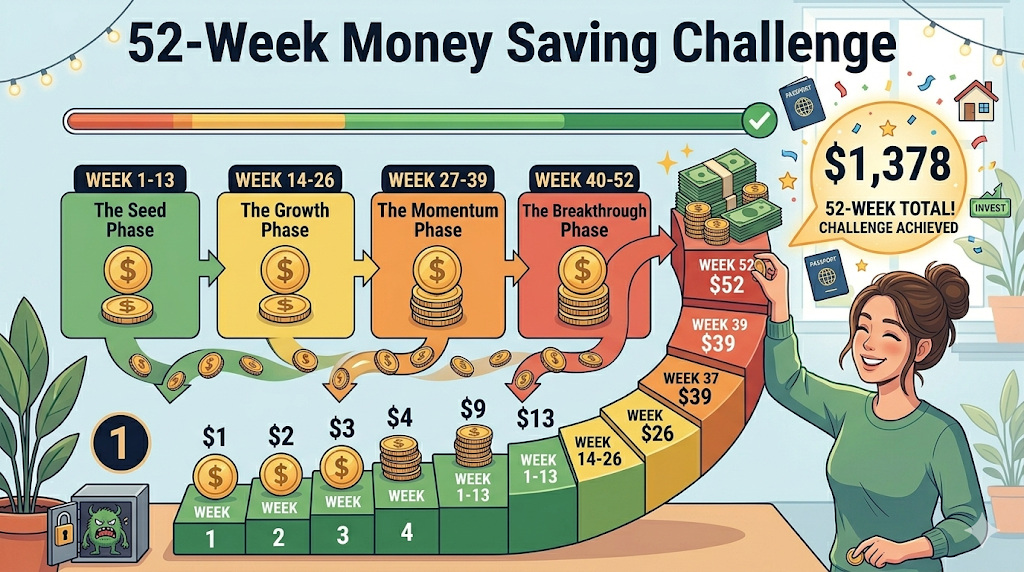
The gradual increase trains your brain to treat saving as a routine — not a sacrifice.
Breaking Down the Numbers: How Much Do You Actually Save?
Here’s where it gets satisfying. The math is simple: you’re essentially adding up all whole numbers from 1 to 52. That gives you a clean total of $1,378. No tricks, no fine print.
The table below shows you a quarterly breakdown so you can see the challenge building in real time:
| Quarter | Weeks | Weekly Range | Quarterly Total | Running Total |
|---|---|---|---|---|
| Q1 — Jan to Mar | 1–13 | $1 – $13 | $91 | $91 |
| Q2 — Apr to Jun | 14–26 | $14 – $26 | $260 | $351 |
| Q3 — Jul to Sep | 27–39 | $27 – $39 | $429 | $780 |
| Q4 — Oct to Dec | 40–52 | $40 – $52 | $598 | $1,378 |
Notice how the final quarter carries most of the weight? That’s by design — but it’s also worth planning for. The weeks leading up to the holidays (when budgets are already tight) are also the weeks you’re saving the most. That’s exactly why so many people swear by the reverse 52-Week Savings Challenge — and we’ll get into that shortly.
Is the 52-Week Money Challenge Realistic on a Low Income?
Real talk: saving $52 in one week is genuinely hard if you’re living paycheck to paycheck. And that’s okay to admit. The classic 52-Week Money Saving Challenge wasn’t designed for everyone’s budget — and pretending otherwise would be dishonest.
But here’s the thing: the framework is more valuable than the specific dollar amounts. There are several modified versions that scale the challenge to what actually works for you:
- The Quarter Version: Start at 25¢ and increase by 25¢ each week. Total saved: ~$344. Still meaningful.
- The Half Version: Save half of each week’s number (50¢, $1, $1.50…). Total: ~$689.
- The Percentage Version: Save a growing percentage of your weekly income instead of fixed dollars — scales beautifully with irregular income.
- The Double Version: If you’ve got room, save $2, $4, $6… and end the year with $2,756. Ambitious, but doable.
SMART Tip:
If you have variable income — gig work, freelance, tips — the percentage-based 52-Week Money Saving Challenge is often the smartest pick. Instead of being locked into a dollar amount, you save a small percentage that grows week by week. It flexes with you.
Do You Have to Save in Cash? (Please Don’t)
Stuffing bills into an envelope every week is charming, sure. But it’s also a fast way to raid your own savings when you’re short $15 on a Tuesday. Financial experts consistently recommend using a dedicated savings account — ideally a high-yield savings account (HYSA) — for exactly this reason. This is especially true for anyone doing the 52-Week Money Saving Challenge, where keeping the money separate helps the weekly deposits add up without temptation.
A high-yield savings account earns you interest on your deposits (often 4–5% APY as of recent years), which means your $1,378 challenge could actually grow a bit beyond that total by December. It also keeps the money mentally separate from your checking account, which matters more than people give credit for. Learn more about why a high-yield savings account is better than cash here: NerdWallet: Best High-Yield Savings Accounts.
| Storage Method | Earns Interest? | Risk of Spending It? | Best For |
|---|---|---|---|
| Cash envelope | No | High | Visual learners / kids |
| Regular savings account | Minimal (0.01%) | Medium | Convenience |
| High-yield savings account | Yes (4–5% APY) | Low | Most people |
| Separate checking account | No | Medium | Those who prefer debit flexibility |
The Reverse 52-Week Savings Challenge: A Smarter Start?
Here’s the version I personally love: flip the whole thing upside down. Start at $52 in January when your New Year motivation is at its peak, and work your way down to $1 in December when gift shopping has already cleaned out your wallet.
The total is identical — $1,378 — but the structure fits real life a lot better. January feels fresh, you have energy, and the big deposits feel manageable. By November and December when money’s tight, you’re only putting in $3, $2, $1. The pressure dissolves exactly when you need it to.
Starting with $52 in January and ending with $1 in December might be the most psychologically intelligent version of this challenge.
Can You Start the 52-Week Challenge in the Middle of the Year?
Absolutely. The challenge isn’t tied to January 1st — that’s just when most people hear about it. You can genuinely start any week of the year. A few ways to adjust:
- Start at week 1 regardless of the calendar date and run for 52 consecutive weeks from your start date.
- Start mid-year but do a 26-week challenge instead, saving $1 to $26. Total: $351 — still great for a 6-month window.
- Start mid-year and pick up at whatever week number corresponds to the current month (e.g., if it’s July, start at week 27).
The best version of this challenge is the one you actually do. Don’t let perfect timing stop you from starting today.
What If I Miss a Week?
Life happens. You forget. You’re short on cash. An unexpected expense shows up. This is completely normal and not a big deal. The 52-Week Money Saving Challenge is not a contract. It’s a habit framework.
You have two good options when you miss a week:
- Skip and continue: Just resume the next week with the correct amount. You’ll finish slightly under $1,378 — but you’ll still have saved hundreds.
- Double up: Combine two weeks into one later payment when you have a little extra cushion.
Either approach is fine. The only genuinely bad option is stopping entirely because you missed one deposit.
Automate the 52-Week Challenge So You Never Have to Think About It
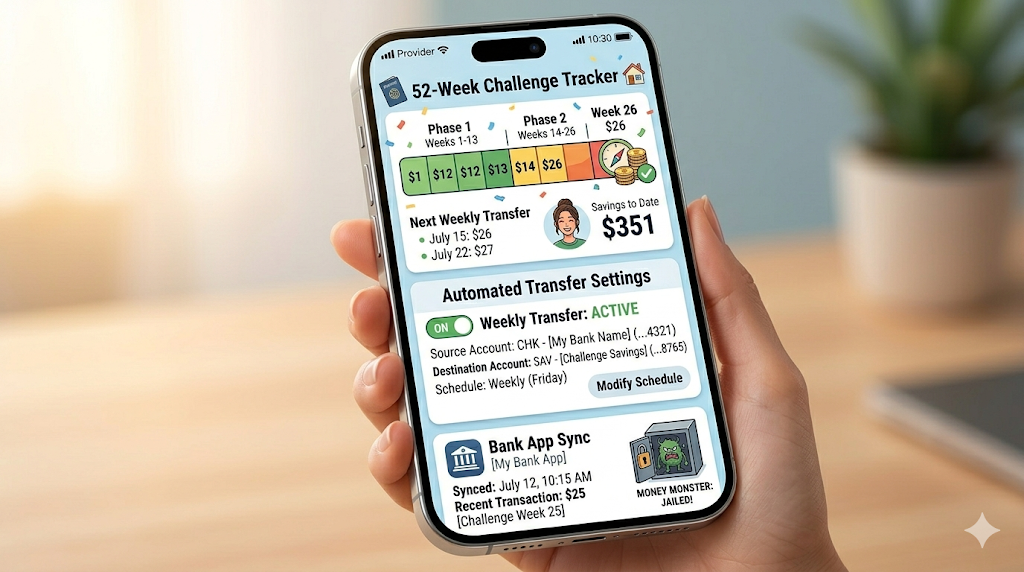
This is the move. Set it and forget it. Many banks — and nearly all major budgeting apps — let you schedule recurring transfers with a custom amount that you can manually update each week. Some apps can even do this automatically based on percentage-based rules.
Popular tools that work well for automating the 52-Week Money Challenge include:
- Ally Bank — Easy recurring transfers; one of the best HYSAs available.
- Marcus by Goldman Sachs — Clean interface, competitive APY, simple transfer scheduling.
- Digit or Qapital — Apps built around automated savings rules; Qapital even has a “52-Week Challenge” preset.
- Your bank’s app — Most major banks allow you to set up a recurring transfer that you update weekly.
How to Stay Motivated Through All 52 Weeks
Name your savings goal. Giving the $1,378 a purpose (“Disney trip,” “emergency fund,” “new laptop”) makes each deposit feel less abstract. This is the first step in making the 52-Week Money Saving Challenge feel achievable and meaningful.
Use a printable tracker. There’s something satisfying about physically checking off each week. A 52-Week Money Challenge printable PDF tracker puts the visual progress right in front of you.
Celebrate milestones. Hit week 13? Acknowledge it. Hit $500? Tell someone. Small wins compound into sustained motivation — exactly what keeps the 52-Week Money Saving Challenge working over 52 weeks.
Find a challenge buddy. Do this with a friend or partner and check in weekly. Accountability is shockingly effective.
Keep the tracker visible. On your fridge, your phone wallpaper, pinned in your notes app — wherever you’ll actually see it.
YOU MAY ALSO LIKE:
The Bottom Line: Small Starts Lead to Real Savings
Here’s what to take away: the 52-Week Money Saving Challenge isn’t magic, and it’s not going to make you wealthy overnight. But it does something more valuable than that: it builds the habit. It teaches your brain that saving isn’t a dramatic act of financial discipline — it’s just what you do on Mondays.
One dollar this week. Two next week. Before you know it, you’re looking at a balance you built entirely on your own, week by week, without ever feeling like you sacrificed something meaningful. That’s $1,378 sitting in a high-yield savings account by December — yours to use for a vacation, an emergency, a goal, or a foundation for something bigger.
So open that savings account. Download that printable tracker. Set that recurring transfer. And start this week — not next January, not next Monday. This week.