10-Minute Easy Home Workout Routine for Beginners Without Equipment to Burn Fat Fast and Stay Active
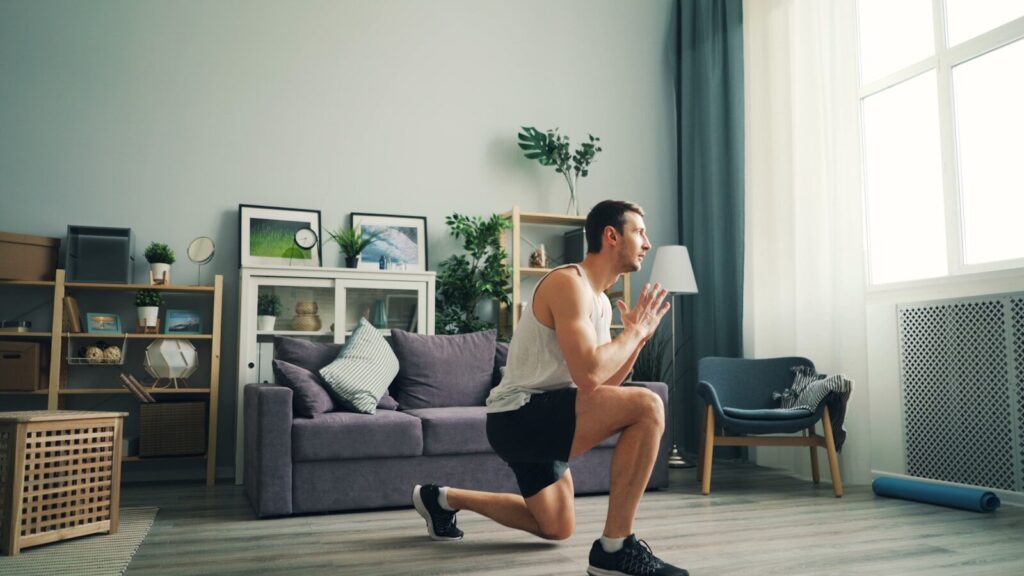
home workout routine for beginners without equipment
Calisthenics Workout Plan for Beginners: Let me paint you a picture. It’s 6 a.m. You set your alarm, you meant to go to the gym — but the bed is warm, the drive sounds awful, and honestly? You’re just not feeling it. So you skip it. Again.
Sound familiar? Yeah. Me too.
Here’s the thing though: you don’t actually need a gym membership, a rack of dumbbells, or a personal trainer to get in shape. A home workout routine for beginners without equipment is all you really need — your body is the only piece of equipment that matters, and you’ve had it this whole time.
This guide is built for beginners who want to get moving, feel better, and build real fitness habits through a home workout routine for beginners without equipment — all from the comfort of home, with zero equipment. Whether you’re starting from scratch or getting back on track after a long break, this no equipment workout plan has everything you need.
What Is the Best Home Workout Routine for Beginners Without Equipment?
The best home workout routine for beginners without equipment is the one you’ll actually stick with. That sounds simple, but it’s the most overlooked truth in fitness. A fancy 5-day split you hate is worse than three simple 20-minute sessions you enjoy.
For a true beginner, the ideal routine checks three boxes:
- It’s short enough to feel doable (think 15–30 minutes)
- It includes a mix of movement patterns — pushing, pulling, hinging, squatting, and core work
- It gives your body time to recover between sessions
A full-body bodyweight workout hits all the major muscle groups and builds a strong foundation before you ever touch a weight. Think of it as learning the language of movement before writing a novel.
How Many Days a Week Should a Beginner Work Out at Home?
Three days a week. That’s the sweet spot for most beginners following a home workout routine for beginners without equipment.
Here’s why: your muscles don’t actually grow during a workout — they grow during rest. When you exercise, you create tiny micro-tears in the muscle fibers. Rest days are when your body repairs those tears and comes back stronger. Skip recovery, and you’re just running yourself into the ground.
As you get comfortable with your home workout routine for beginners without equipment, you can move to four days. But starting with three is smart, sustainable, and science-backed.
Here’s a sample weekly schedule that works well:
| Day | Focus | Duration | Intensity |
| Monday | Full-Body Circuit | 20 min | Low |
| Tuesday | Rest or Walk | 20–30 min | Very Low |
| Wednesday | Core & Legs | 20 min | Low |
| Thursday | Rest or Stretch | 15 min | Very Low |
| Friday | Upper Body | 20 min | Low–Moderate |
| Saturday | Active Recovery | 20–30 min | Low |
| Sunday | Full Rest | — | — |
Notice how workouts are spread out, with rest or light movement in between. That’s intentional. Your body needs the breathing room.
How Long Should a Home Workout Routine for Beginners Without Equipment Last?
20 minutes. That’s it. That’s enough — especially at the start.
Look, there’s a common misconception that a workout doesn’t count unless you’re drenched in sweat for an hour. That’s just not true. For someone just starting out, a focused 20-minute bodyweight session can be more effective than a wandering 60-minute gym visit where half the time is spent figuring out what to do next.
Here’s a realistic time breakdown for a 20-minute beginner session:
- 3–5 minutes: Warm-up (light cardio, dynamic stretching)
- 12–15 minutes: Main workout (circuit of 4–6 exercises)
- 2–3 minutes: Cool-down and stretch
Once you’re a few weeks in and starting to feel stronger, push it to 30 minutes. But don’t feel like you need to — 20 minutes done consistently beats 60 minutes done occasionally every single time.
Do I Need a Warm-Up Before a Home Workout?
Yes. Always. Non-negotiable.
Jumping straight into squats or push-ups with cold muscles is how people get hurt. A proper warm-up increases blood flow to your muscles, improves your range of motion, and mentally signals that it’s game time.
Quick 5-Minute Beginner Warm-Up:
- 30 seconds marching in place
- 30 seconds arm circles (forward and back)
- 30 seconds hip circles
- 30 seconds leg swings (each side)
- 30 seconds jumping jacks (low-impact step-outs work too)
- 30 seconds torso twists
That’s it. Six moves, five minutes, and you’re ready to train without risking an injury that sidelines you for two weeks.

What Exercises Can I Do at Home Without Equipment?
More than you think. Bodyweight training is one of the most underrated forms of exercise, and the variety of movements you can do is genuinely impressive.
Lower Body:
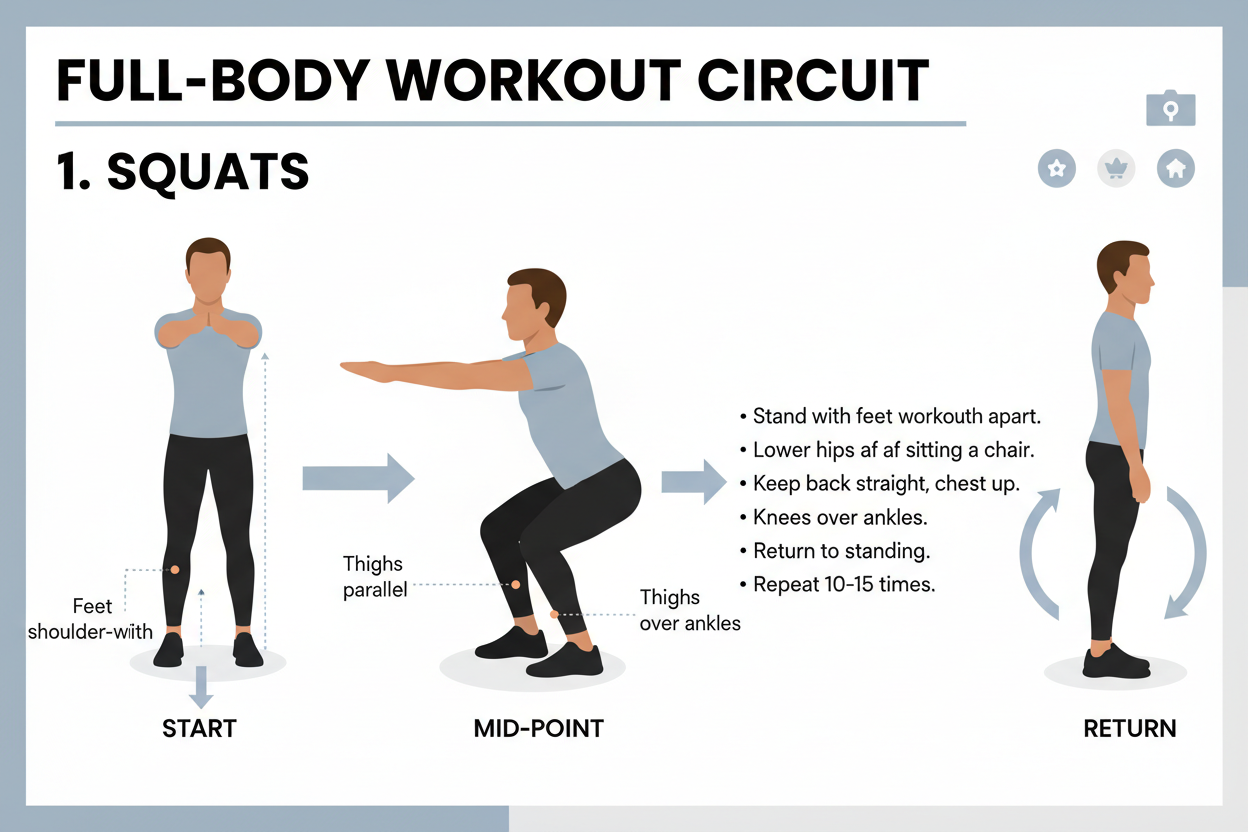
- Squats — the king of all leg exercises
- Reverse lunges — easier on the knees than forward lunges
- Glute bridges — great for the posterior chain
- Wall sits — brutal in the best way
- Calf raises
Upper Body:
- Push-ups (and their many variations — wide, narrow, incline, decline)
- Tricep dips off a chair
- Pike push-ups (shoulder-focused)
- Superman holds (for the upper back)
Core:
- Planks (front and side)
- Dead bugs
- Bicycle crunches
- Leg raises
- Mountain climbers
Cardio / Full-Body:
- Jumping jacks
- High knees
- Burpees (if you dare)
- Bear crawls
Mix and match these into circuits, and you’ve got a full-body no equipment workout that rivals anything you’d do at a gym.
A Good Full-Body Workout at Home for Beginners
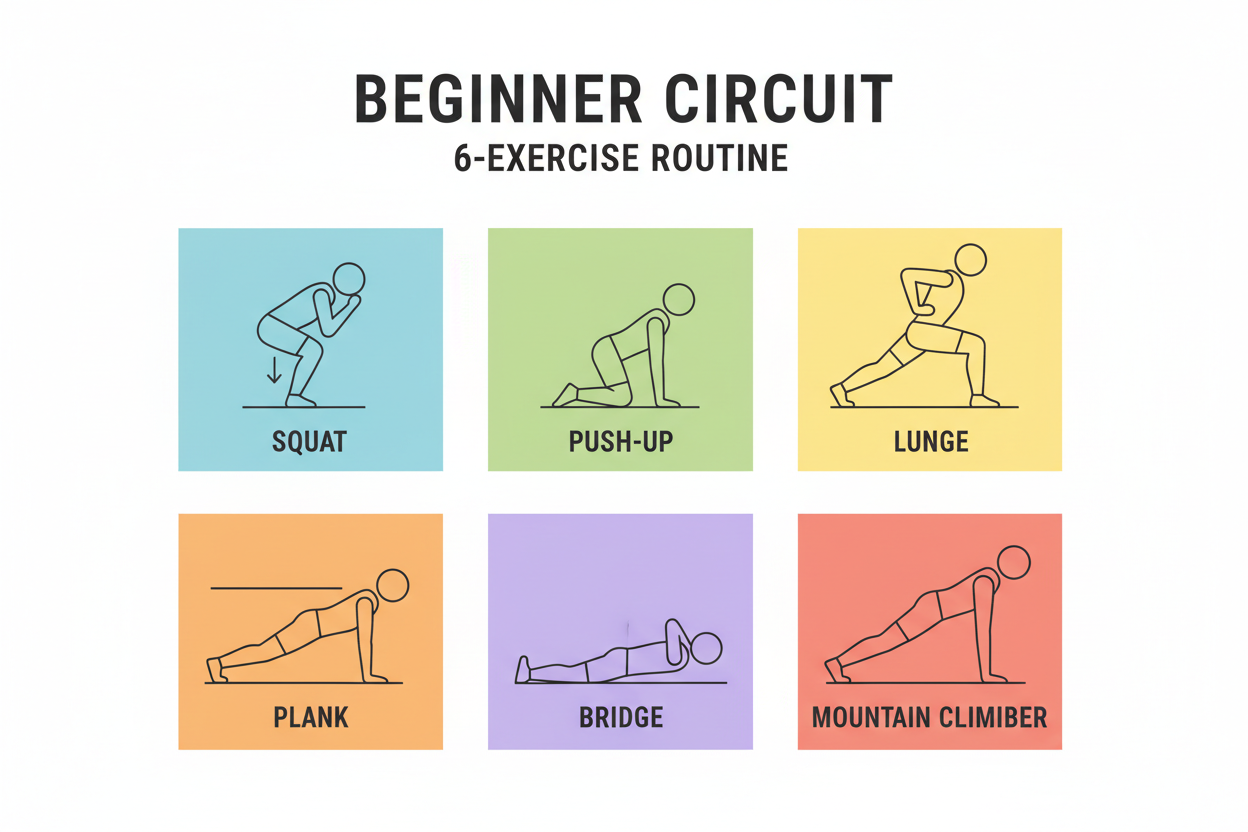
Here’s a simple, effective beginner bodyweight circuit you can do right now. No equipment, no special space — just you and maybe six feet of clear floor.
Beginner Full-Body Circuit (20 Minutes)
Do each exercise for 30 seconds, rest 15 seconds between exercises. Complete 3 rounds with 60 seconds of rest between each round.
- Bodyweight squats
- Push-ups (drop to knees if needed — no shame in it)
- Reverse lunges (alternating legs)
- Plank hold
- Glute bridges
- Mountain climbers
Pro tip: As you get stronger, increase to 45 seconds per exercise, or add an extra round. Progress doesn’t always mean doing more — sometimes it means doing it better.
How Many Reps Should a Beginner Do?
This depends on your goal. There isn’t one magic number — it’s about matching your reps and sets to what you’re actually trying to achieve.
| Goal | Sets | Reps / Duration |
| Lose Weight | 2–3 | 15–20 reps |
| Build Muscle | 3–4 | 8–12 reps |
| Build Endurance | 2–3 | 20–30 sec |
| General Fitness | 2–3 | 10–15 reps |
For most beginners, starting with 2–3 sets of 10–15 reps of each exercise is a smart baseline. Focus on form first, reps second. A perfect squat beats five sloppy ones every time.
Can I Lose Weight With a No-Equipment Home Workout?
Absolutely — but let’s be real about how it works.
Exercise burns calories. Calories burned + a modest calorie deficit = weight loss. It’s not complicated, but it does require consistency over weeks and months, not days.
Bodyweight training can absolutely help you lose weight. High-rep circuits keep your heart rate elevated, which boosts calorie burn. Exercises like burpees, high knees, and mountain climbers are especially effective for a full-body no equipment workout aimed at weight loss.
That said, you can’t out-exercise a bad diet. If fat loss is your goal, pair your home workout routine with mindful eating — more whole foods, fewer processed ones, and enough protein to protect muscle mass as you lose fat. For a structured approach to your diet, you can follow the CDC Healthy Eating Guidelines to better manage your daily calorie needs.
Realistic expectation: Most beginners can expect to lose 0.5–1 pound per week with consistent training and a slight calorie deficit. Slow? Maybe. Sustainable? Absolutely.
Can I Build Muscle Without Gym Equipment?
Yes — and this might surprise you.
Your muscles don’t know whether you’re pushing against a barbell or the floor. They respond to tension, time under tension, and progressive overload. Bodyweight training can deliver all three.
The key is progression. Once 15 push-ups feel easy, you don’t just stop — you make them harder. Try:
- Slowing the movement down (3 seconds down, 1 second up)
- Reducing rest time between sets
- Trying a harder variation (archer push-ups, diamond push-ups)
- Adding more sets
That principle — gradually making things harder — is called progressive overload, and it’s the foundation of every successful strength program, gym or no gym.
Is Bodyweight Training Enough for Beginners?
For beginners, a home workout routine for beginners without equipment is more than enough.
In fact, mastering bodyweight movement before adding external weight is arguably the smarter approach. You build body awareness, joint stability, and movement patterns that will serve you for life — whether you eventually add weights or not.
Plenty of elite athletes and military personnel rely heavily on bodyweight training. It’s not a consolation prize for people who can’t afford a gym. It’s a legitimate, challenging, and effective training method.
What to Do If an Exercise Feels Too Hard
Modify it. Immediately and without guilt.
Fitness is not a test of willpower — it’s a practice of consistency. If standard push-ups wreck your wrists or your form completely collapses, drop to your knees. If lunges feel unstable, stand next to a wall for balance. If a plank on your toes is impossible right now, do it on your knees.
Every elite athlete was once a beginner who couldn’t do things properly. The modification is the training — not a failure to train.
As your body adapts over weeks and months, you’ll find those modified versions getting easier. That’s progress. That’s the whole point.
How to Stay Consistent With Your Home Workout Routine for Beginners Without Equipment
This is where most people struggle — not the workouts themselves, but doing them over and over again when life gets busy, motivation dips, or Netflix is calling.
Here’s what actually works:
Schedule it like a meeting. Put your home workout routine for beginners without equipment in your calendar. Treat it as non-negotiable.
Start embarrassingly small. A 10-minute beginner home workout done daily builds a habit faster than an intense 45-minute session done twice a month.
Track your progress. A simple notebook or phone note works. Seeing progress keeps you going.
Find an accountability partner. A friend, a Reddit community, a fitness app — whatever works for you.
Forgive missed days instantly. One skipped workout means nothing. Skipping three weeks in a row means you need to reconnect with your why.
The secret? Consistency always beats intensity. Show up imperfectly, again and again, and the results will follow.
You May Like :home workout routine for beginners without equipment
Conclusion – Start Today
Here’s the truth about getting fit at home: with a home workout routine for beginners without equipment, you already have everything you need. No gym, no gear, no excuses.
Start with three days a week. Do 20 minutes. Warm up, hit your home workout routine for beginners without equipment, cool down. Rest. Repeat. That’s it. That’s the whole plan.
The hardest part isn’t the push-ups or the lunges — it’s showing up on day one. And then day two. And then day fifteen when the novelty has worn off and you’d rather sit on the couch.
But here’s what happens when you push through your home workout routine for beginners without equipment consistently: you start to feel stronger, move better, sleep deeper, and carry yourself differently. That’s not hype — that’s what consistent bodyweight training does to a human body.
Your challenge: Do the beginner full-body circuit from this home workout routine for beginners without equipment today. Right now, if you can. Don’t wait for Monday, don’t wait for the “right” moment. Just start — and let momentum do the rest.
Written for fitness enthusiasts and beginners across the United States | Always consult a healthcare professional before beginning any new exercise program.
Written for fitness enthusiasts and beginners across the United States | Always consult a healthcare professional before beginning any new exercise program.