Table of Contents
How to Budget When You Are Broke: nobody sits down and thinks, “You know what sounds fun? Making a budget with zero dollars.” And yet here you are. Maybe rent is due, your account balance is giving you anxiety, and the idea of “budgeting” feels like being told to organize a house that’s already on fire. I get it. And I’m not here to judge.
Here’s what I will tell you: a bare-bones budget when you’re broke is actually simpler than a regular budget, not harder. There’s less to track. Less room for guesswork. When every dollar is spoken for before it arrives, money gets easier to manage not because you have more of it, but because you stop pretending it’ll figure itself out.
- 64% of Americans live paycheck to paycheck at some point in their lives
- $0 is how much savings you need to START a working budget
- 30 days is all it takes to see a real shift in spending behavior
If those numbers hit close to home, you’re in exactly the right place. Let’s build your broke budget step by step, with no condescension and no fluff.
This Guide Is For You If:
- 💸 Money disappears before the month is even over
- 🔄 You’re stuck living paycheck to paycheck with no end in sight
- 📋 You’ve tried budgeting before and it just didn’t stick

First Things First
What Does “Budgeting When Broke” Actually Mean?
When you’re figuring out How to Budget When You Are Broke, it helps to understand that this isn’t a typical budgeting situation. A regular budget assumes some wiggle room — a little for savings here, some fun money there. A broke budget is different. It’s a survival-first, essentials-only framework where you map out the bare minimum your life requires and work entirely within that.
Think of it less like a financial plan and more like a triage system. You’re not optimizing right now. You’re stabilizing. And that’s perfectly okay because stabilizing is the foundation everything else gets built on.
The goal of a zero budget when broke isn’t to feel restricted forever. It’s to stop the bleeding, see your actual financial picture clearly, and start making tiny moves in the right direction.
STEP01-Figure Out Your Real Monthly Income
When you’re learning How to Budget When You Are Broke, the first step is getting clear on one hard number: how much money actually lands in your account each month. Not what your job pays on paper. Not what you hope to make with overtime. What reliably hits your bank account after you must have settled taxes.
If your income does not come regularly—gig work, freelance, tips, part-time shifts: use your lowest month from the past three as your baseline. Budgeting from your worst month means any extra income becomes a genuine bonus rather than a crutch you depend on.
If Your Income Is $0 Right Now
Even here, understanding How to Budget When You Are Broke still applies — you arguably need a system more than anyone. Map out your essential expenses anyway. This tells you exactly how much you need to earn to survive, which becomes important when job hunting, applying for assistance, or deciding which gig to prioritize.
STEP02-List Your Bare Minimum Expenses — Honestly
This is where most people flinch. But the whole point of a broke budget is honesty over comfort. Write down every expense, then separate them into two buckets: survival expenses and everything else.
Survival Expenses (Non-Negotiables)
- Rent or mortgage
- Electricity and water
- Groceries (not restaurants — actual groceries)
- Transportation to work (gas, bus pass, or car payment)
- Health insurance or critical medications
- Phone bill (if needed for work or job searching)
- Minimum debt payments (to avoid collections)
Everything Else (Temporary Pause List)
- Streaming subscriptions
- Gym memberships
- Dining out
- Non-essential shopping
- Entertainment apps and services
Everything in the second column is temporarily paused, not permanently cut. You’re not becoming a monk. You’re buying yourself breathing room.
STEP03-Build Your Zero-Based Budget From Scratch
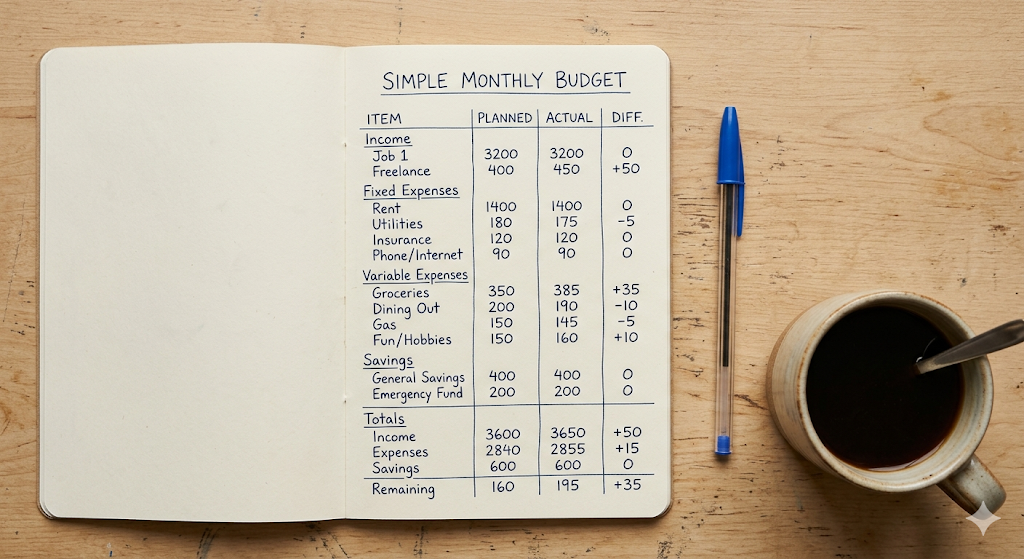
Zero-based budgeting is the most powerful broke budget method and it sounds more complicated than it is. The concept is simple: income minus all expenses equals zero. Every dollar gets a job before the month starts.
Here’s what that looks like in practice for someone earning $1,800/month:
| Category | Monthly Amount | Notes |
|---|---|---|
| Rent | $800 | Non-negotiable |
| Utilities | $120 | Electric + water |
| Groceries | $200 | Meal-planned, no waste |
| Transportation | $150 | Gas or bus pass |
| Phone | $50 | Basic plan only |
| Minimum Debt Payments | $100 | Keep accounts current |
| Emergency Micro-Fund | $30 | Automatic transfer, day one |
| Personal Buffer | $350 | Toiletries, laundry, small needs |
| Total | $1,800 | Every dollar assigned |
Notice that $30 emergency fund line. It looks tiny. Over a year, that’s $360 — enough to absorb a car repair, a medical copay, or a busted appliance without going into debt. Start small. Start now.
STEP04-Track Every Single Dollar — Even the Uncomfortable Ones
Tracking spending is the part people skip. It’s also the part that makes the biggest difference. You don’t need a fancy system. You need any system you’ll actually use.
Here are your realistic options, from zero cost to low cost:
| Method | Cost | Best For |
|---|---|---|
| PocketGuard | Free | Seeing what’s safe to spend in real time |
| Goodbudget | Free | Envelope-style budgeting, no bank link needed |
| Empower Dashboard | Free | Full financial picture, spending + net worth |
| Google Sheets | Free | Custom control, no app required |
| Notebook + pen | Free | If you don’t trust apps or don’t have stable data |
| YNAB | ~$14.99/mo | Serious zero-based budgeting with full methodology |
If you genuinely don’t have a banking app and prefer to track manually, that works too. Log every purchase the same day it happens even a $1.50 vending machine trip. The friction of writing it down is the point. It changes how you spend without requiring any willpower.
STEP05-Prioritize Bills When You Can’t Pay All of Them
This is the question nobody wants to have to ask but when you’re truly broke, it’s a real one: what do I pay first when I can’t pay everything?
When you’re figuring out How to Budget When You Are Broke, prioritization becomes everything. Here’s the hierarchy, based on real-world consequences:
- Housing — eviction and foreclosure have long-lasting legal and credit consequences
- Utilities — electricity and heat shutoffs create emergency situations fast
- Food — before any bill, you need to eat
- Transportation to work — if you lose the ability to get to work, everything gets worse
- Health insurance / medications — a medical emergency without coverage is devastating
- Minimum debt payments — to avoid collections and credit damage
- Everything else — after the above are covered
If You Can’t Pay a Bill — Call First
Most utility companies, landlords, and lenders have hardship programs they don’t advertise. Calling before you miss a payment gives you far more options than calling after. Ask specifically:
“Do you have a hardship plan or deferral option?”
You’d be surprised how often the answer is yes. You can also check eligibility for LIHEAP (Low Income Home Energy Assistance Program) for utility support.
STEP06-Cut Costs Drastically — Without Feeling Deprived
There’s a right way and a wrong way to cut expenses when broke. The wrong way is eliminating every small joy until you feel so miserable you abandon the whole budget in week two. The right way is cutting strategically — starting with the expenses that hurt the least and deliver the most savings.
- Audit subscriptions immediately — the average household pays for 4+ subscriptions they barely use. Cancel all but the one you’d genuinely miss most.
- Switch to generic grocery brands — quality is nearly identical on staples like rice, pasta, canned goods, and cleaning products. Savings: 20–40% per trip.
- Meal plan every week — food waste is one of the most expensive invisible habits. A weekly plan eliminates it entirely.
- Use Rakuten or Honey for any online shopping — cashback on purchases you’d make anyway is free money.
- Freeze credit cards — literally. Put them in a cup of water in the freezer. The 20-minute defrost creates enough friction to kill impulse buys.

STEP07-Avoid Impulse Buying When Money Is Scarce
Impulse spending hits harder when you’re broke: not because broke people spend more impulsively, but because there’s no financial cushion to absorb it. A $40 impulse buy when you have $47 in your account is a crisis. The same purchase with $4,000 in the account is barely noticeable.
Practical impulse-control strategies that actually work:
- The 24-hour rule — want something? Wait 24 hours. Most impulse urges dissolve on their own.
- Unsubscribe from retail emails — you can’t impulse-buy what you don’t see. Mass unsubscribes in five minutes using Unroll.me.
- Shop with a list, always — never enter a store, physically or digitally, without a predetermined list.
- Give yourself a small “no questions asked” allowance — even $10/week. Having some guilt-free spending built into the budget paradoxically reduces impulsive overspending.
STEP08-Build a Micro Emergency Fund — Even from Zero
This is the most important thing you can do with your broke budget, and it sounds the most impossible. Save when you have nothing? Yes. Even $5 a week.
If you’re serious about How to Budget When You Are Broke, this step is non-negotiable. Here’s why: without an emergency fund, every unexpected expense: a $200 car repair, a medical bill, a broken phone becomes debt. And debt when you’re already broke is the engine of staying broke. A small buffer breaks that cycle.
How to Build It from Absolute Zero
- Open a separate savings account — ideally a high-yield savings account so your money earns something while it waits
- Set an automatic transfer of whatever you can afford — $10, $25, even $5 — on payday
- Sell unused items on Facebook Marketplace or OfferUp and put 100% into the fund
- Direct any unexpected money — tax refund, birthday cash, side hustle earnings — straight here first
- Don’t touch it. Label it “Emergency Only” in your banking app if you can
Your goal is $500 first. Not $1,000. Not three months of expenses. Just $500. That single number quietly changes your entire financial situation.

STEP09-Use Free Tools and Resources You Didn’t Know Existed
Being broke doesn’t mean you’re on your own. There are genuinely useful free resources: government programs, nonprofit services, and community tools — that exist specifically for financial hardship situations.
| Resource | What It Helps With | Where to Find It |
|---|---|---|
| LIHEAP | Help paying energy bills | acf.hhs.gov |
| Feeding America | Local food bank finder | feedingamerica.org |
| Benefits.gov | All federal assistance programs | benefits.gov |
| 211.org | Local assistance for bills, food, housing | Dial 2-1-1 or visit 211.org |
| NFCC | Free nonprofit credit counseling | nfcc.org |
These aren’t charity. They’re programs you’ve likely paid into through taxes. Use them without shame: that’s what they’re there for.
STEP10-Stick to the Budget, Then Slowly Rebuild
The hardest part of a broke budget isn’t making it. It’s maintaining it week three, when the novelty wears off and the vending machine in the break room starts looking like a reasonable decision.
When you’re mastering How to Budget When You Are Broke, a few habits genuinely help:
- Weekly money check-in — 15 minutes every Sunday. Review what you spent, adjust if needed, reset for the week ahead. No judgment, just data.
- Celebrate the small wins — hit a week without impulse buys? Acknowledge it. Saved your first $100? That’s worth noting. Progress reinforces progress.
- Revisit the budget monthly — your situation will change. Income goes up or down, bills shift. Treat your budget as a living document, not a set-it-and-forget-it system.
- Add back one “want” at a time — as your situation improves, slowly reintroduce small enjoyments. This makes the process sustainable, not miserable.
Recovery from being broke is not a straight line. It’s two steps forward, one step back, and then two more forward. The budget is just the map, you’re the one doing the walking.
Check Out: How to Manage Money When Broke: 10 Practical Steps for 2026
The Bottom Line
When it comes to How to Budget When You Are Broke, it’s not about perfection. It’s not about having the right app, the prettiest spreadsheet, or following every rule exactly as written. It’s about knowing your numbers, making a plan, and showing up for that plan even when it’s uncomfortable.
The truth is the people who escape financial hardship aren’t smarter or luckier than you. They just got honest about where their money was going, stopped pretending a budget wasn’t necessary, and started making small, consistent decisions in the right direction.
That’s available to you too. Starting today. Starting with this. Pick one step from this guide — just one — and do it before you close this tab. The momentum you build from that single action is more valuable than any financial tip you’ll ever read.
Frequently Asked Questions
How do I start a budget with no savings?
When learning How to Budget When You Are Broke, start with income, not savings. Write down what reliably comes in each month, list your survival expenses, and assign every dollar before it arrives. A budget doesn’t require savings to exist — it’s a plan, not a balance.
What are the bare minimum expenses to cover when broke?
When you’re working out How to Budget When You Are Broke, housing, utilities, food, transportation to work, and critical health costs come first. Those five categories are your survival expenses. Everything else is secondary until your situation stabilizes.
Can I budget effectively on a single low income?
Yes — and when learning How to Budget When You Are Broke, a tight income actually makes zero-based budgeting more effective, not less, because every dollar matters and you’ll feel the difference immediately. Use your real take-home pay as your starting number and work strictly within it.
How do I track spending without a banking app?
When tracking spending for How to Budget When You Are Broke, a small notebook works perfectly. Log every purchase the same day it happens — amount, category, and what it was. Weekly totals by category give you a clear picture without any technology required.
Should I cut subscriptions first when broke?
Yes — when learning How to Budget When You Are Broke, subscriptions are the easiest first cut because they’re recurring, often forgotten, and painless to cancel. Audit every subscription, keep one at most, and cancel the rest. You can always resubscribe when you’re stable.
Found This Helpful?
Share it with someone who needs a real, judgment-free starting point. Then explore more practical money guides on our blog — no jargon, no shame, just steps that work.Read More Money Tips →
© 2026 Financial Wellness Blog | Not financial advice. Consult a qualified financial professional for your specific situation.