How to Fall Asleep Fast: 13 Proven Tips That Actually Work
Introduction
It’s 1:47 a.m. You’ve been lying in the dark for over an hour. Your brain is replaying that awkward thing you said three years ago—or maybe running a mental to-do list for tomorrow. Sound familiar?
You’re not alone. The CDC reports that 30.5% of American adults sleep fewer than seven hours a night, and millions more struggle with the most frustrating part: actually falling asleep. If you’re tired of staring at the ceiling, this guide is for you.
Learning how to fall asleep fast doesn’t require expensive gadgets or prescription pills. It comes down to understanding what your brain and body need and giving it to them quickly and consistently. Whether you need to fall asleep fast in five minutes or just want to stop dreading bedtime, these 13 proven techniques will actually work.
Table of Contents
What Stops You From Falling Asleep Fast?
Before you can fix the problem, it helps to understand it. Sleep-onset insomnia—the inability to fall asleep quickly—is usually caused by one of three things:
- A racing mind full of worries, replays, or tomorrow’s plans
- Physical tension from a stressful day that hasn’t left your muscles
- A bedroom environment that’s fighting your biology (light, heat, screens)
The good news? All three have clear, research-backed solutions. Here’s how to fall asleep fast, starting with the most powerful techniques first.
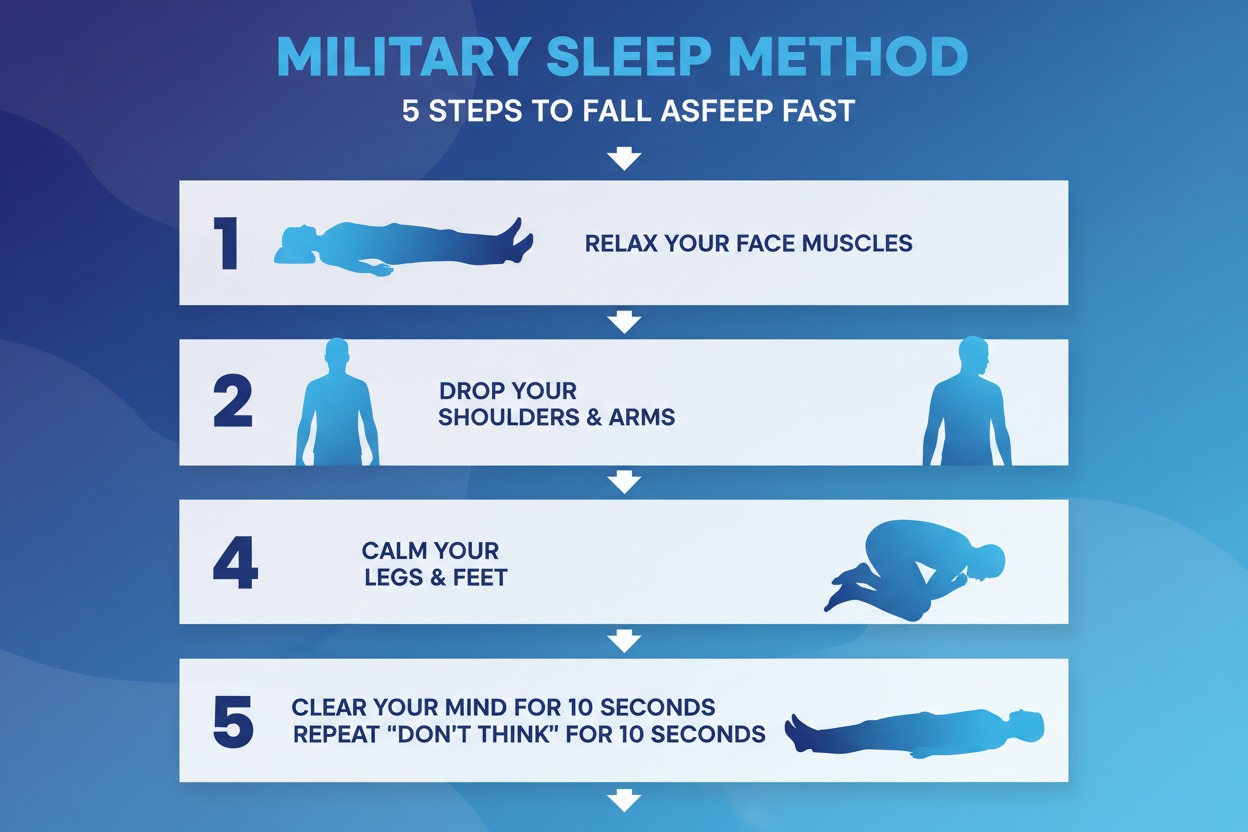
1. Use the Military Sleep Method to Fall Asleep Fast in 5 Minutes
If you want to know how to fall asleep fast — like, really fast — start here. The military sleep method was reportedly developed to help soldiers sleep under stressful field conditions. According to Relax and Win: Championship Performance by Lloyd Bud Winter, it allowed soldiers to fall asleep in under two minutes after six weeks of practice.
Here’s how to do it:
- Relax every muscle in your face — forehead, eyes, jaw, tongue
- Drop your shoulders down as far as they’ll go; let both arms go limp
- Take a deep breath and fully relax your chest
- Relax your lower body — thighs, calves, and feet
- Clear your mind completely for 10 seconds. Visualize floating in a canoe on a calm lake, lying in a black velvet hammock, or lying in a meadow under a still blue sky. If visualization fails, repeat ‘don’t think’ for 10 seconds
Practice this every night, and falling asleep fast becomes muscle memory.
2. Try 4-7-8 Breathing to Fall Asleep Fast
If there’s a single breathing technique that changed how people fall asleep fast, it’s the 4-7-8 method, developed by Andrew Weil. It’s rooted in pranayama yoga and directly activates your parasympathetic nervous system—your body’s natural “rest and digest” mode.
A 2022 study published in Physiological Reports showed that this breathing pattern improves heart rate variability and reduces blood pressure within minutes. Dr. Weil notes that 4–6 weeks of consistent practice can measurably lower resting heart rate.
For a deeper explanation of how the technique works, you can read more here: 4-7-8 breathing technique guide
How to do 4-7-8 breathing:
- Press your tongue tip gently behind your upper front teeth
- Exhale completely through your mouth
- Close your mouth. Inhale through your nose for 4 seconds
- Hold your breath for 7 seconds
- Exhale slowly and fully through your mouth for 8 seconds
- Repeat this cycle 4 times
The extended exhale is what does the heavy lifting — it triggers a drop in heart rate and tells your nervous system the threat is over. You can also see more about how breathing affects sleep and stress response here: Sleep Foundation – breathing and relaxation techniques
This is one of the most effective ways to fall asleep fast when anxiety is in the picture.
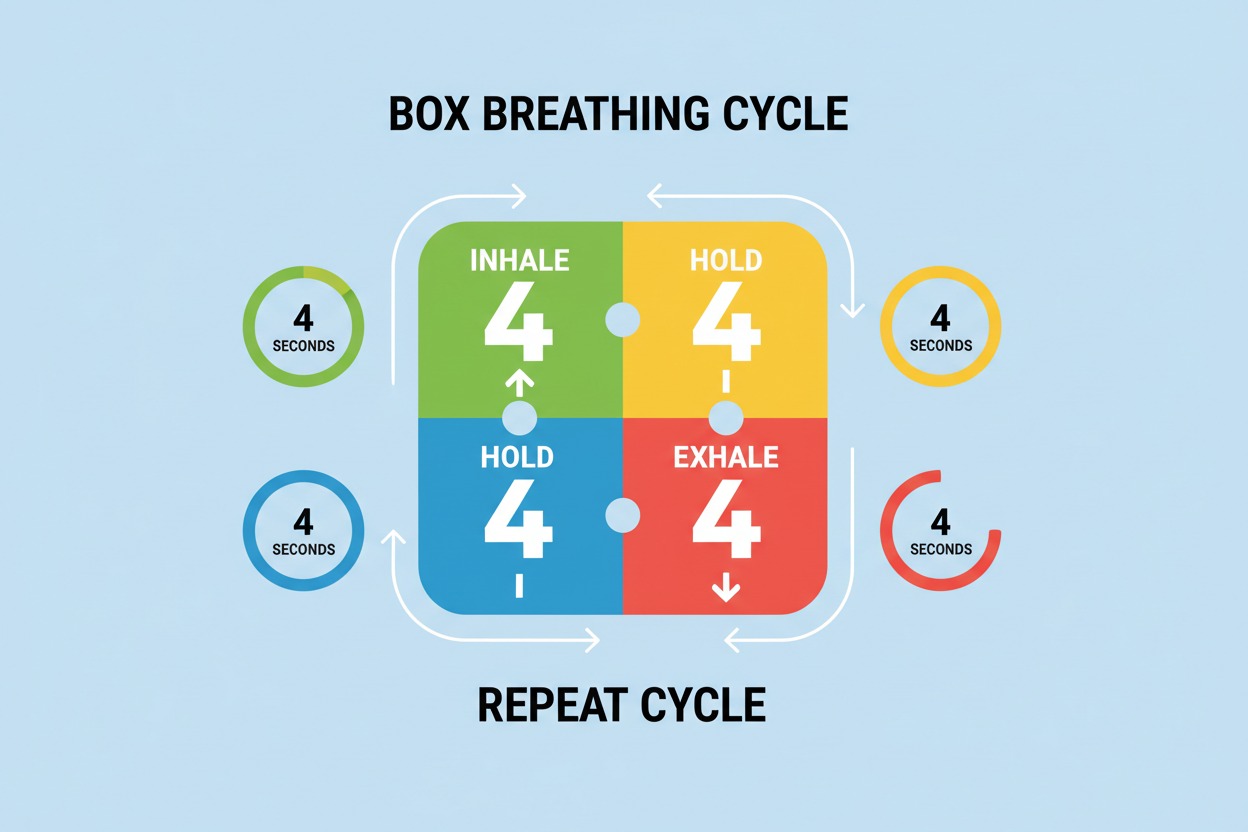
3. Practice Box Breathing (4-4-4-4) to Fall Asleep Fast
Navy SEALs use box breathing — also called tactical breathing — to stay calm in high-stress operations. If it works when someone’s being shot at, it can absolutely help you fall asleep fast after a rough Wednesday.
A landmark 2025 meta-analysis of 52 randomized controlled trials with 3,900 participants found that box breathing reduces cortisol by 32%, improves heart rate variability by 48%, and activates the vagus nerve. Just 5-10 minutes daily shows measurable effects.
Box breathing steps:
- Inhale through your nose for 4 seconds
- Hold for 4 seconds
- Exhale through your mouth for 4 seconds
- Hold again for 4 seconds
- Repeat 4-6 times
Box breathing works by slowing your breathing rate to approximately 0.1 Hz, a frequency shown to be highly effective for sleep initiation. It’s one of the most accessible ways to fall asleep fast without medication.
You may Also Like: 7 Signs Your Cortisol Levels Are Too High (And What to Do About It)
4. Use Progressive Muscle Relaxation (PMR) to Fall Asleep Fast
Progressive muscle relaxation works by systematically tensing then releasing muscles from head to toe. The contrast between tension and release signals to your brain that it’s safe to let go.
A 2025 study in Frontiers in Psychiatry found that combining mindfulness with PMR significantly reduced insomnia severity and sleep medication use in participants. If you’re trying to fall asleep fast without pills, this is one of your most powerful tools.
Quick PMR guide:
- Start with your feet—tense for 5 seconds, then release
- Move to calves, thighs, stomach, hands, arms, shoulders, and face
- With each release, breathe out and consciously notice the relaxation
5. Follow the 20-Minute Rule (CBT-I Stimulus Control)
Here’s a counterintuitive one: if you can’t fall asleep fast, get out of bed.
The NHS and sleep specialists trained in Cognitive Behavioral Therapy for Insomnia (CBT-I)—the gold standard treatment for sleep disorders—recommend stimulus control therapy. The 20-minute rule is simple: if you haven’t fallen asleep in approximately 20 minutes, get out of bed, go to another room, and do a quiet, non-stimulating activity like reading under a dim lamp. Return to bed only when you feel genuinely sleepy.
Why? When you lie awake frustrated in your bed night after night, your brain literally begins to associate your bed with wakefulness and anxiety. The 20-minute rule breaks that encoding and retrains your brain to connect bed with sleep only.
6. Quiet Your Racing Mind With Visualization
Your brain needs something to do if you’re going to fall asleep fast. Left to its own devices, it’ll replay your emails or rehearse tomorrow’s hard conversation. Give it a job.
The most effective sleep visualizations:
- Floating in a canoe on a calm lake — imagine the gentle rock of the water
- Lying in a black velvet hammock in a dark room — soft, enveloping, still
- Lying in a green meadow — warm sunlight, soft breeze, no agenda
- Watching clouds drift slowly overhead
If your mind wanders, gently bring it back. If you simply can’t visualize, use the ‘don’t think’ mantra—repeat it for 10 seconds to crowd out intrusive thoughts.
7. Optimize Your Bedroom Temperature to Fall Asleep Fast
Your body temperature naturally drops as you fall asleep. If your bedroom is too warm, that process gets disrupted, and you’ll struggle to fall asleep fast no matter what else you try.
The optimal bedroom temperature for sleep is 65°F (18°C), with an effective range of 60-67°F (15-19°C).
Other environment tweaks that help you fall asleep fast:
- Blackout curtains — complete darkness supports melatonin production
- Eye mask — useful if you can’t control outside light
- White noise machine — masks disruptions like traffic or neighbors
- Blue light blocking glasses—wear 1 hour before bed if using screens
8. Get Morning Sunlight to Fall Asleep Fast at Night
This one surprises people: what you do at 7 a.m. directly affects how fast you fall asleep at 11 p.m.
Exposure to natural sunlight within 30 minutes of waking sets your circadian rhythm — the biological clock that determines when you feel alert and when you feel sleepy. Without it, your clock drifts and your sleep timing becomes unpredictable.
Aim for 10–30 minutes of direct sunlight each morning. Overcast skies still count — outdoor light is exponentially brighter than indoor lighting even on cloudy days.
9. Take a Warm Bath Before Bed to Fall Asleep Fast
A warm bath 1-2 hours before bed actually lowers your core body temperature, which is exactly what your body needs to fall asleep fast.
When you step out of a warm bath, your body rapidly dissipates heat through your skin. This controlled drop mimics the natural temperature decline that signals sleep onset. A 2019 meta-analysis in Sleep Medicine Reviews confirmed that bathing in water between 104 and 109°F (40 and 43°C) one to two hours before bed improved both sleep quality and sleep onset time.
10. Make a ‘Worry List’ to Fall Asleep Fast With a Busy Mind
Trying to clear your mind by sheer willpower doesn’t work. Instead, give your anxious thoughts somewhere to live before you get into bed.
15-30 minutes before bed, take a notebook and dump every worry, task, or unresolved thought onto the page. Research from Baylor University found that people who wrote a to-do list before bed — specifically listing tasks for the next day — fell asleep significantly faster than those who journaled about completed tasks.
When your brain knows the information is safely stored, it lets go.
11. Use Evidence-Based Sleep Supplements to Fall Asleep Fast
For nights when you need extra help, these supplements have actual research behind them:
| Supplement | Dosage | Evidence |
| Glycine | 3g before bed | 2007 Japan study: faster sleep onset, less daytime fatigue. 2024 study: improved objective sleep quality |
| Valerian Root | 300-600mg, up to 1hr before bed | 2021 study: improved sleep quality, anxiety, and depression. 2006 meta-analysis confirmed sleep latency benefits |
| Magnesium Glycinate | 200-400mg | Supports muscle relaxation and GABA neurotransmitter activity |
| L-Theanine | 100-200mg | Promotes calming alpha brain waves associated with sleep transition |
| Lemon Balm | 300-600mg | 2025 research: reduced insomnia severity in study participants |
| Melatonin | 0.5-3mg | NSF: 88% of users report falling asleep faster |
Note: Always consult a healthcare provider before starting any supplement, especially if you take other medications.
12. Limit Blue Light Exposure to Fall Asleep Fast
Screens emit blue-wavelength light that suppresses melatonin production—the hormone that signals your brain it’s time to sleep. Using your phone right up until bedtime is essentially telling your brain it’s noon.
The fix:
- Ideally: No screens 1 hour before bed
- Alternatively: Use blue light-blocking glasses for the hour before sleep
- Adjust settings: Enable Night Mode on all devices after sunset
13. Don’t Try to Fall Asleep Fast — Use Paradoxical Intention
Paradoxical intention is a CBT-I technique where you lie in bed with your eyes open and try to stay awake. It sounds counterproductive, but research shows this reduces the performance anxiety around sleep onset that often keeps people up the most.
By removing the pressure to fall asleep fast, you ironically fall asleep faster. Studies have shown this technique reduces sleep onset time significantly, particularly in people with sleep anxiety. Try it on a night when you feel especially ‘wired but tired.’
Bonus: What to Do When You Wake Up at 3 a.m.
- Don’t look at the clock—it creates cortisol-spiking anxiety
- Try 4-7-8 breathing for two to three cycles
- Use visualization (the canoe, the hammock)
- If still awake after 20 minutes, apply the 20-minute rule—get up, read in dim light, return when sleepy
- Avoid your phone at all costs
Conclusion: You Can Fall Asleep Fast — Tonight
There’s no magic bullet for sleep, but there are proven systems. The techniques in this guide are backed by research, used by everyone from Navy SEALs to sleep specialists, and most importantly—they work without a prescription.
Start with one or two: the military sleep method, the popular breathing technique known as the 4-7-8 breathing method, or simply fixing your bedroom temperature to 65°F. Build on what works. Within a few weeks, falling asleep fast won’t feel like a battle—it’ll feel natural.
Your body wants to sleep. You just have to stop getting in its way.
You May Also Like: Improve Sleep Quality: Evidence-Based Tips That Work
FAQ: How to Fall Asleep Fast
How can I fall asleep fast in 5 minutes?
Use the military sleep method: progressively relax your face, shoulders, chest, and legs, then clear your mind with visualization or by repeating ‘don’t think’ for 10 seconds.
What is the 4-7-8 breathing technique for sleep?
Press your tongue behind your upper teeth, exhale fully, then inhale for 4 seconds, hold for 7, and exhale for 8. Repeat 4 cycles. It activates your parasympathetic nervous system and reduces heart rate rapidly.
What to do when you can’t fall asleep after 20 minutes?
Follow the CBT-I 20-minute rule: get out of bed, go to a dim room, do a quiet activity, and return only when genuinely sleepy. This prevents your brain from associating your bed with wakefulness.
Does glycine help you fall asleep faster?
Yes. A 2007 Japanese study found that 3g of glycine taken before bed produced faster sleep onset and reduced daytime fatigue. A 2024 follow-up confirmed improved objective sleep quality vs. placebo.
What bedroom temperature helps you fall asleep fast?
65°F (18°C) is optimal, within a recommended range of 60-67°F (15-19°C). Cooler temperatures support your body’s natural pre-sleep temperature drop.
Does morning sunlight really help you fall asleep fast?
Yes. Getting 10-30 minutes of natural sunlight within 30 minutes of waking sets your circadian rhythm and advances your sleep phase, making it easier to fall asleep fast at your target bedtime.