10 Best Low Impact Cardio Workouts for Beginners at Home
Let’s be honest — the idea of jumping around your living room, gasping for air after 60 seconds, doesn’t exactly sound like a great time. If high-intensity workouts have ever made you want to close your laptop and go back to the couch, you’re not alone.
The good news? You don’t need to jump, sprint, or suffer to get a seriously effective cardio workout. Low impact cardio workouts for beginners at home are proof that gentle movement can absolutely transform your fitness — no equipment, no gym, and no pain required.
Whether you’re dealing with bad knees, just getting started on your fitness journey, working out in a small apartment, or simply tired of workouts that feel like punishment — this guide is for you. We’re breaking down everything: the best exercises, a beginner-friendly routine, how to actually lose weight with low-impact training, and the science behind why it works.
Let’s get into it.
What Are Low Impact Cardio Workouts?#
Low impact cardio refers to any cardiovascular exercise where at least one foot stays on the ground at all times. There’s no jumping, no hopping, no pounding — just smooth, controlled movement that raises your heart rate without stressing your joints.
Think of exercises like marching in place, step jacks, knee raises, or side steps. They look simple. But done consistently at a moderate-to-brisk pace, they challenge your cardiovascular system, burn calories, and build stamina — just like their high-intensity counterparts. Research from the American College of Sports Medicine (ACSM) shows that regular aerobic exercise can improve cardiovascular fitness, support weight management, and enhance overall health, regardless of whether the activity is high or low impact.
Why Low Impact Cardio Is More Effective Than You Think#
Research consistently shows that moderate-intensity, sustained exercise delivers comparable cardiovascular benefits to high-intensity training — especially for beginners whose bodies haven’t yet adapted to heavy workloads. A study published in the Journal of the American College of Cardiology found that even low-intensity running (which mirrors the intensity of brisk low-impact cardio) significantly reduces cardiovascular risk over time.
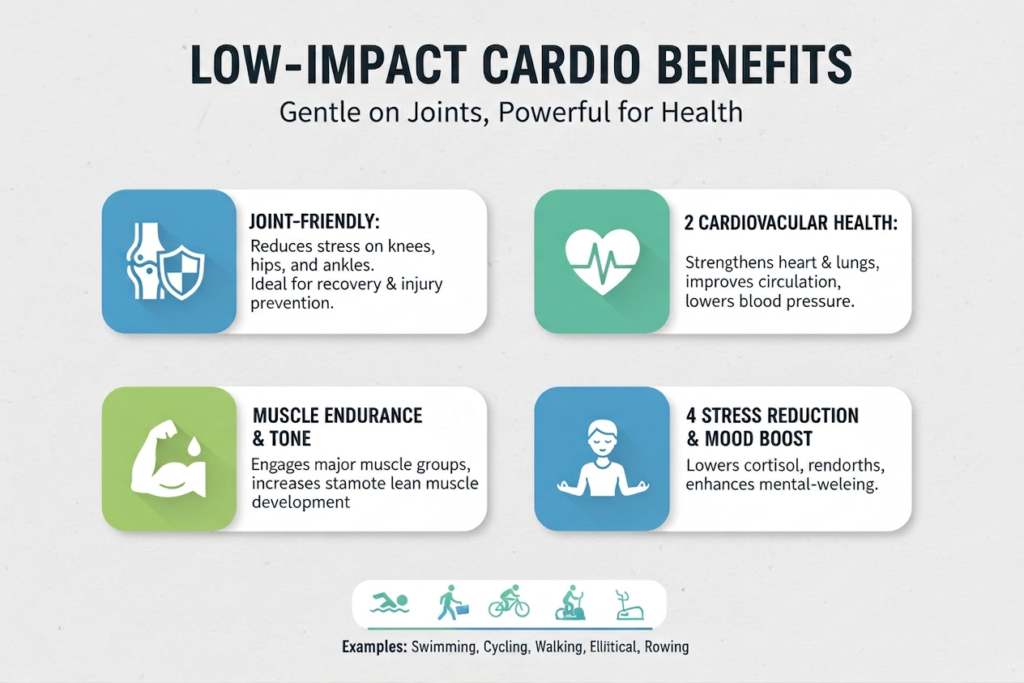
The key benefits include:
- Burns fat and supports healthy weight management
- Improves cardiovascular health and lung capacity
- Boosts energy levels and reduces fatigue
- Reduces stress and improves mood (hello, endorphins)
- Protects joints while still strengthening supporting muscles
- Accessible to virtually everyone — any age, any fitness level
Before you dive in, do yourself a favor and grab a decent workout mat if you don’t already have one. Your hardwood floor is not your friend during a 20-minute cardio session. A good non-slip exercise mat will protect your knees, give you better grip, and make every move feel smoother. Your joints will thank you.
Who Should Do Low Impact Cardio at Home?#
The short answer? Almost everyone. But low impact cardio is especially great for:
- Beginners who are new to exercise and want to build a foundation
- People with bad knees, hip pain, or joint issues
- Seniors and older adults looking to stay active safely
- Apartment dwellers who need quiet, neighbor-friendly workouts
- Postpartum women easing back into fitness
- Anyone recovering from an injury
- People who simply prefer a lower-stress approach to cardio
If any of those describe you — this is your lane. You don’t have to earn the right to work out gently. Gentle IS the workout.
10 Best Low Impact Cardio Workouts for Beginners at Home#
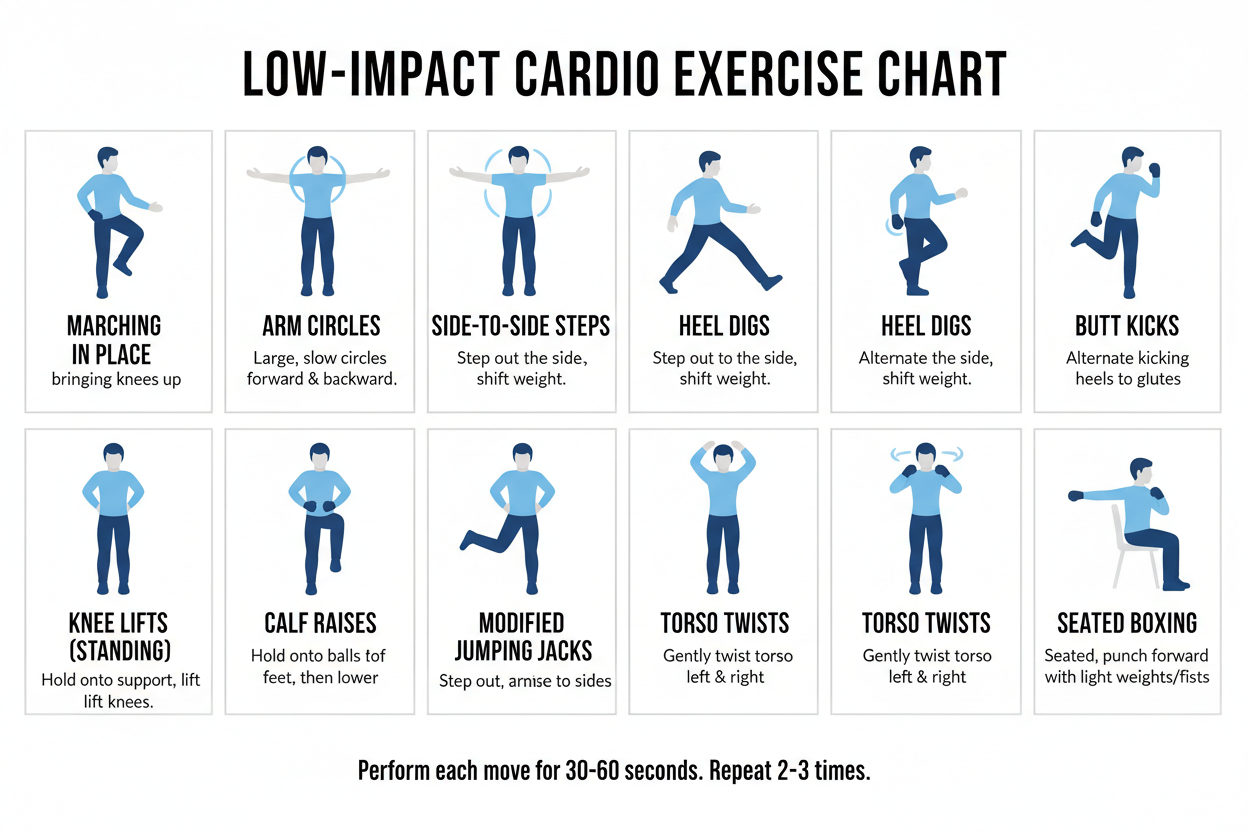
You don’t need a single piece of equipment for any of these. Just enough floor space to move comfortably and a pair of supportive shoes (or bare feet, if you prefer).
If your feet feel sore or fatigued after cardio sessions, your shoes might be the culprit. Most people work out in whatever sneakers are lying around — but the right pair of cross-training shoes gives you the grip and cushioning you actually need to move confidently through every exercise on this list.
1. Marching in Place#
Best for: Total beginners, bad knees, seniors
This is the foundation of any beginner low impact cardio routine. Lift your knees to hip height, swing your arms naturally, and keep a brisk pace. It sounds too easy — until you’ve done it for 3 minutes straight. Your heart rate will tell a different story.
Duration: 2–3 minutes per set
2. Step Jacks (Low Impact Jumping Jacks)#
Best for: Replacing jumping jacks without the impact
Instead of jumping both feet out, step one foot out to the side, then the other, while raising your arms overhead. Same cardio payoff — zero joint stress. This is one of the most underrated no jumping cardio moves you can do at home.
Duration: 45–60 seconds per set
3. Knee Raises#
Best for: Core activation + cardio combo
Stand tall and alternate lifting each knee toward your chest in a controlled, rhythmic motion. Engage your core throughout. Move faster as you warm up. If you want to level it up, bring your opposite elbow down to meet each knee.
Duration: 45–60 seconds per set
4. Side Steps#
Best for: Inner thighs, glutes, and coordination
Step side-to-side in a wide stance, touching your feet together in the middle before stepping out again. Add a clap or arm raise to increase intensity and heart rate. Great for small spaces and apartment workouts.
Duration: 60 seconds per set
5. Low Impact Skaters#
Best for: Balance, glutes, and lateral movement
Mimic the movement of a speed skater — step one foot diagonally behind you, lean slightly forward, and swing your arms. No jumping, no plyometric push. Just smooth, rhythmic side-to-side movement that engages your entire lower body.
Duration: 45 seconds per set
6. Standing Bicycle Crunches#
Best for: Core and cardio together
Stand with hands behind your head and bring alternate knees up while twisting your opposite elbow toward them. This keeps your heart rate elevated while working your obliques — a great full body low impact cardio exercise.
Duration: 45 seconds per set
7. Squat to Calf Raise#
Best for: Lower body strength + cardio
Lower into a squat, then as you stand, rise onto your toes for a calf raise. The continuous up-down motion gets your heart pumping while targeting quads, hamstrings, glutes, and calves.
Duration: 60 seconds per set
8. Low Impact Burpees#
Best for: Full-body conditioning without the jump
Start standing. Step one foot back, then the other into a plank position. Step forward again and stand up tall. That’s one rep. Slow and controlled, but still a full-body move that challenges your endurance. A true beginner-friendly alternative to the classic burpee.
Duration: 45 seconds per set
9. Seated Cardio (Chair Marches)#
Best for: Seniors, mobility-limited individuals
Sit in a sturdy chair, sit tall, and alternate lifting each knee while pumping your arms. It’s surprisingly effective and perfect for those who need a fully seated low impact cardio option.
Duration: 2–3 minutes per set
10. Heel Digs + Front Kicks (Dance-Style)#
Best for: Fun, rhythm-based cardio
Alternate tapping your heel forward and flicking your opposite foot out in a front kick motion. Add arm swings and hip sway to make it feel more like a dance routine than exercise. (Because honestly, cardio should be at least a little fun.)
Duration: 60 seconds per set
Read Also: 15 Effective Low Impact Workouts for Seniors: Safe, Easy, and Joint-Friendly
Sample 20-Minute Beginner Low Impact Cardio Routine#
Here’s a simple structure you can follow 3–5 times per week. No equipment needed. Just you, your living room floor, and about 20 minutes.
| Exercise | Duration | Rest | Sets |
| Warm-Up: Marching in Place | 3 minutes | — | 1 |
| Step Jacks | 45 seconds | 15 seconds | 2 |
| Knee Raises | 45 seconds | 15 seconds | 2 |
| Side Steps | 60 seconds | 15 seconds | 2 |
| Low Impact Skaters | 45 seconds | 20 seconds | 2 |
| Squat to Calf Raise | 60 seconds | 20 seconds | 2 |
| Standing Bicycle Crunches | 45 seconds | 15 seconds | 2 |
| Low Impact Burpees | 45 seconds | 20 seconds | 2 |
| Cool-Down: Slow Marching + Stretching | 3 minutes | — | 1 |
Total time: ~20 minutes | Estimated calories burned: 150–220 calories (varies by weight and effort)
As you get stronger, extend each interval, add a third set, or reduce rest time. The goal is progressive improvement — not perfection.
Here’s a small investment that pays off big: a fitness tracker. Once you start seeing your heart rate, step count, and calories burned in real time, you become way more consistent. It turns every workout into something measurable — and measurable things improve faster. Check out this beginner-friendly option that works great for home cardio sessions like this one.
Can You Really Lose Weight with Low Impact Cardio at Home?#
Yes — and the science backs it up. Weight loss comes down to creating a calorie deficit, and low impact cardio absolutely contributes to that. A 150-pound person can burn 200–300 calories during a 30-minute low impact cardio session, depending on intensity.
But here’s the real key:
Consistency beats intensity every time — especially for beginners.
High-impact workouts often lead to injury, burnout, and quitting. Low impact cardio, on the other hand, is sustainable. You can do it daily without wrecking your body, which means you actually stick with it — and that’s where the results come from.
To maximize fat loss:
- Keep your heart rate in the moderate zone (50–70% of max HR)
- Use interval-style circuits (work 45 sec, rest 15 sec) to spike calorie burn
- Aim for at least 150 minutes of moderate cardio per week (CDC guidelines)
- Pair your workouts with a balanced, whole-food diet
- Stay hydrated — even light dehydration blunts performance
Here’s something most beginners skip that makes a massive difference — writing it down. Tracking your workouts, how you felt, and what you ate creates a feedback loop that accelerates your progress faster than any workout plan alone. This fitness journal is simple, beginner-friendly, and keeps you honest with yourself without feeling overwhelming.
Low Impact vs High Impact Cardio: Which Is Better for Beginners?#
Neither is universally better — they serve different purposes. But for beginners working out at home, low impact wins on almost every practical metric.
| Factor | Low Impact Cardio | High Impact Cardio |
| Joint Stress | Minimal | High |
| Injury Risk for Beginners | Low | Moderate–High |
| Suitable for Bad Knees | Yes | No |
| Apartment-Friendly (Quiet) | Yes | No |
| Calorie Burn (30 min) | 200–280 cal | 280–400 cal |
| Recovery Time Needed | Low — can do daily | Higher — needs rest days |
| Sustainable Long-Term | Very High | Moderate |
| Beginner-Friendly | Excellent | Challenging |
Bottom line: if you’re starting from zero or have any joint concerns, low impact cardio at home is the smarter, safer, and more sustainable starting point. You can always add high-impact elements as you build fitness.
Read Also: Low Impact Workouts for Weight Loss: The Complete Guide to Joint-Friendly Fitness
Tips for Staying Consistent as a Beginner#
Starting is the easy part. Showing up on day 12 when the novelty has worn off — that’s the real challenge. Here’s how to make it stick:
- Start small. Ten minutes is better than zero. Really.
- Schedule it like a meeting. Put it in your calendar and treat it as non-negotiable.
- Track your progress. Even a simple notes app log builds momentum.
- Pair it with something you enjoy — a podcast, music playlist, or your favourite show.
- Find a beginner workout community or accountability partner online.
- Don’t wait to feel motivated — motivation follows action, not the other way around.

Conclusion: Your Low Impact Journey Starts Today#
You don’t have to destroy your body to get fit. You don’t need fancy equipment, a gym membership, or a brutally intense training plan to see real results. What you need is consistency, a smart approach, and exercises that work with your body — not against it.
Low impact cardio workouts for beginners at home are one of the most effective and underrated tools in fitness. They burn fat, protect your joints, improve your heart health, and — most importantly — they’re sustainable enough that you’ll actually stick with them.
Start with the 20-minute routine above. Do it 3 times this week. Track how you feel. Then come back next week and do it again. Small, consistent action is how every transformation begins.
If you’re looking for additional guidance on physical activity recommendations for adults, the World Health Organization (WHO) Physical Activity Guidelines provide science-backed recommendations for improving health, fitness, and long-term wellbeing.
You May Also Like: 7 Powerful Daily Fitness Routine for Beginners at Home to Lose Weight Fast
Frequently Asked Questions #
What are low impact cardio workouts for beginners at home?#
A: Low impact cardio workouts for beginners at home are exercises that elevate your heart rate without jumping or high-impact movements. Popular examples include marching in place, step jacks, knee raises, low-impact skaters, side steps, and seated cardio routines. They’re perfect for beginners because they’re joint-friendly, require no equipment, and can be done in any small space.
Are low impact cardio workouts effective for weight loss?#
A: Yes — low impact cardio can absolutely support weight loss. The key is keeping your heart rate elevated, staying consistent, and pairing your workouts with a healthy diet. Using interval-style circuits (working hard for 45 seconds, resting for 15) helps increase calorie burn without adding joint stress.
Can I do low impact cardio at home without equipment?#
A: Absolutely. All the exercises in this guide require zero equipment. Moves like marching, step jacks, squats, knee raises, front kicks, side steps, and dance-style cardio work perfectly with nothing but floor space and your own bodyweight.
How long should a beginner low impact cardio workout be?#
A: For beginners, 10–20 minutes is a great starting point. As your stamina improves, gradually work up to 20–30-minute sessions. Even a 10-minute low impact cardio workout done consistently will produce real results over time.
How often should beginners do low impact cardio at home?#
A: Aim for 3–5 sessions per week. On some days, keep the intensity easy; on others, push a little harder or go longer. Rest or gentle stretching on your off days is completely fine — your body needs recovery time too.
What low impact cardio exercises are best for beginners with bad knees?#
A: The best options for bad knees include marching in place, seated chair marches, knee raises with gentle taps, step jacks (no jumping), low impact skaters, side steps, and V-steps. These minimize knee stress while still giving you an effective cardiovascular workout.